

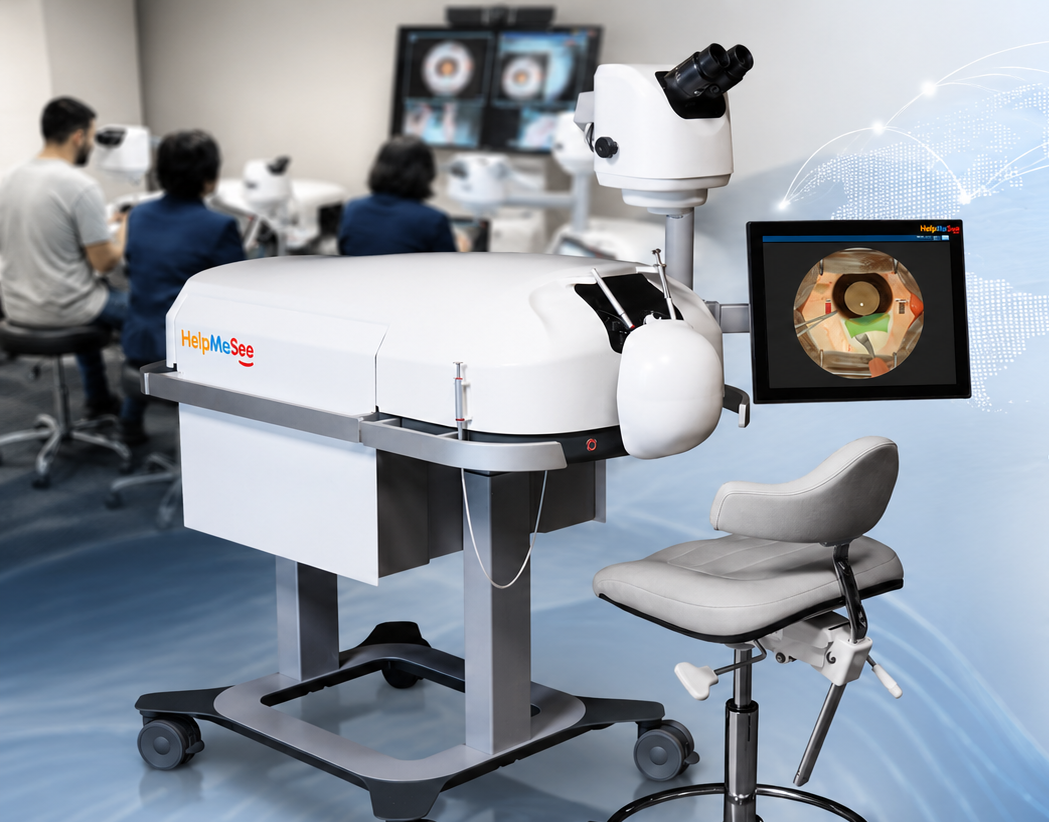
For generations, cataract surgery education followed a familiar model: observe experienced surgeons, practice under supervision, and gradually gain confidence through live patient cases.
While this apprenticeship model has produced skilled surgeons around the world, the demands of modern ophthalmology are driving a significant shift in how cataract specialists are trained.
In 2026, simulation-based education is becoming an increasingly important component of cataract surgery training programs worldwide. Advances in virtual reality (VR) simulation now allow trainees to practice procedures, manage complications, learn from mistakes, and receive immediate feedback before ever operating on a patient.[1]
For educators, this represents more than a technological advancement. It reflects a broader movement toward competency-based medical education, where surgical proficiency is developed through structured practice and objective assessment rather than relying mostly on experience gained in live surgery.
Learning From Complications Without Putting Patients at Risk
One of the greatest challenges in surgical education is that complications made during training can have real consequences. In cataract surgery, errors such as posterior capsule rupture, improper wound construction, excessive tissue manipulation, or poor instrument positioning can affect surgical outcomes and increase the complexity of a procedure.
Historically, cataract surgeon trainees learned to recognize and manage these challenges primarily in the operating room. Today, simulation-based education provides a safer approach.
Virtual reality simulators create a risk-free learning environment where trainees can practice procedures repeatedly, experience complications, and learn from errors without jeopardizing patient safety.[2]
This ability to safely fail is one of simulation’s greatest educational strengths. Rather than avoiding complications, trainees are encouraged to encounter them, understand why they occurred, and develop strategies to manage them in future procedures.
Error Recognition Is Becoming a Critical Surgical Skill
Experienced cataract surgeons often identify potential problems before complications occur. Developing this ability is an essential part of surgical mastery. Modern VR simulators are uniquely positioned to teach these skills because they continuously monitor performance throughout a procedure.
When cataract surgeon trainees apply excessive force, position instruments incorrectly, damage tissue, deviate from ideal surgical technique, or trigger a simulated game-over, the system provides immediate feedback.[3] Research has shown that learners consistently identify real-time feedback on incorrect actions as one of the most valuable features of virtual simulation training.[4]
This immediate feedback helps trainees recognize patterns that may lead to complications and reinforces safer surgical techniques through repetition. Instead of discovering complications after surgery has been completed, learners can manage them at the moment they occur.
For MSICS education, this creates an accelerated learning curve where technical errors become teaching opportunities rather than patient safety risks.
Preparing for Complications Before They Happen
Complication management remains one of the most difficult aspects of cataract surgery training. Many complications occur infrequently, making it difficult for trainees to gain meaningful experience managing them during residency alone. Yet cataract surgeons must be prepared to respond effectively when complications arise. Simulation-based education allows educators to intentionally expose trainees to challenging scenarios that may otherwise take years to encounter in clinical practice.[5]
Posterior capsule rupture, challenging cataract cases, and other high-risk events can be recreated repeatedly in a controlled environment. Learners can practice the specific steps to manage these occurrences until their response becomes second nature. This approach helps transform complication management from a theoretical concept into a practical skill developed through experience.
As a result, simulation is increasingly being viewed not only as a tool for technical skills training, but also as a platform for improving surgical judgment, decision-making, and preparedness.[6]
A Shift Toward Competency-Based Surgical Education
The growing adoption of simulation reflects a larger evolution occurring throughout medical education. Rather than measuring readiness based solely on the number of procedures completed, many training programs are placing greater emphasis on demonstrated competency.
Virtual reality simulators support this shift by providing objective performance metrics that can track skill development over time. Surgical precision, efficiency, tissue handling, instrument control, and complication avoidance can all be measured and assessed consistently.[7]
This allows trainees to identify specific areas for improvement and gives educators a clearer understanding of when a learner is ready to progress. Simulation transforms surgical training from a process based primarily on exposure into one focused on measurable skill acquisition.
The Evidence Supporting Simulation-Based Learning Continues to Grow
The movement toward simulation-first education is supported by an expanding body of evidence. A 2026 systematic review and meta-analysis involving more than 1,500 ophthalmology trainees found that extended reality simulation improved surgical performance, reduced intraoperative complications, shortened operative times, and increased trainee confidence.[1]
Other studies have demonstrated that simulation training can improve technical performance while helping learners develop critical non-technical skills such as situational awareness, communication, and decision-making.[6]
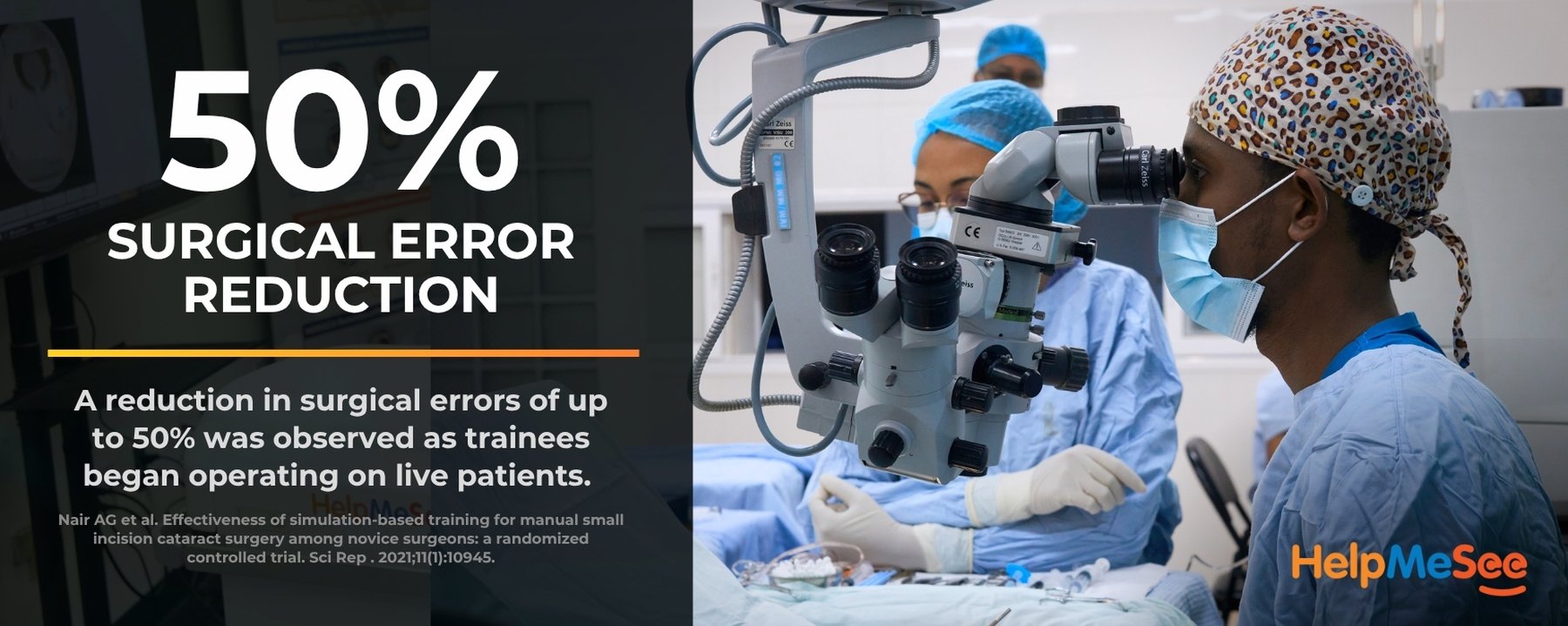
Research also suggests that virtual reality training contributes to fewer complications and improved efficiency when trainees transition to live cataract surgery.[8]
Taken together, these findings reinforce the growing consensus that simulation-based education can strengthen surgical preparation while supporting patient safety.
The Future of MSICS Training
As the demand for cataract surgery continues to grow worldwide, training programs face increasing pressure to produce competent cataract surgeons efficiently and safely.
Virtual reality simulation is helping address this challenge by creating an environment where trainees can practice repeatedly, make mistakes safely, receive immediate feedback, and learn to avoid complications before entering the operating room.
The result is a fundamental shift in surgical education.
Rather than learning primarily through patient-based experience, the next generation of cataract surgeons is increasingly developing core skills through simulation-based education first and then refining those skills in clinical practice.
In 2026, this approach is no longer viewed as an educational supplement. It is becoming an essential part of how modern cataract surgery training is delivered.
REFERENCES
- Jiang Y, Ge S and Ke B (2026) Impact of extended reality (XR) simulation on ophthalmology training outcomes: an updated systematic review and meta-analysis. Front. Med. 13:1823359. doi: 10.3389/fmed.2026.1823359
Ahuja AS, Yang S, Paredes AA III, Tu DC. Virtual Reality in Ophthalmic Surgical Education: Current Innovations and Future Perspectives. Clinical Ophthalmology. 2026.
Ashraf NN, Saleem T. Simulation Cataract Surgery, an Analysis on its Impact on the Training of Post Graduate Trainees. Medical Forum. 2026.
Xiang X, Zhu X, Ji Z, Lu M. Application of Virtual Simulation Teaching Model in Enhancing Clinical Understanding of Cataract Surgery Among Undergraduate Medical Students. Research Square. 2026.
Solecki L, Yaïci R, Sidhoum L, et al. Virtual Reality Simulator-Based Assessment of Non-Technical Skills in Eye Surgery: Managing Complex Cataract Surgery. BMC Medical Education. 2026.
Martin GC, Huaulmé A, Cavaillé M, et al. Cataract Surgery in a Simulated Operating Room Environment: A Pilot Study. Canadian Journal of Ophthalmology. 2026.
Nguyen G, Pham MT, Kang PC. The Use and Perceptions of Virtual Reality Simulator Training for Ophthalmological Surgical Education. Journal of Academic Ophthalmology. 2026.
Rothschild P, Richardson A, Beltz J, et al. Effect of Virtual Reality Simulation Training on Real-Life Cataract Surgery Complications: Systematic Literature Review. Journal of Cataract & Refractive Surgery. 2021.


 Spanish
  English
  French