


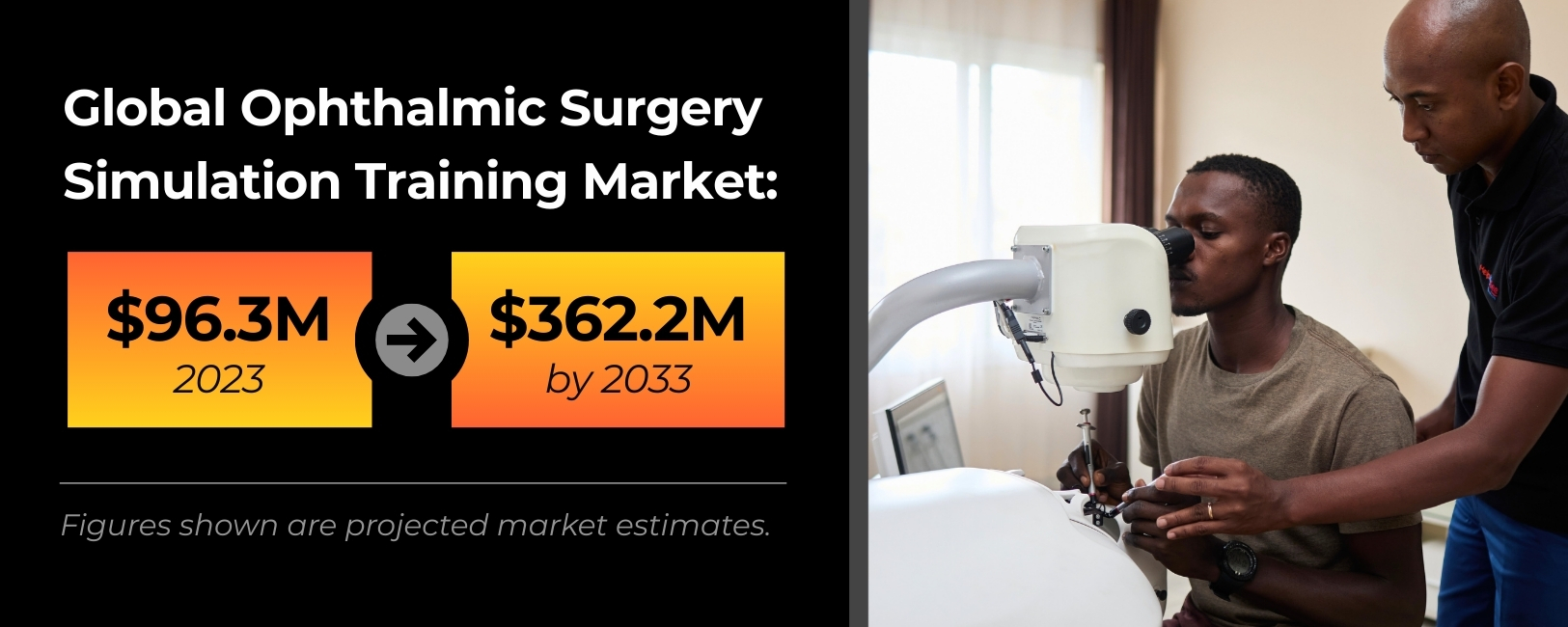
Financial estimates indicate that the global market for ophthalmic surgery simulation training is on an accelerated trajectory. Valued at $96.3 million in 2023, it is projected to reach $362.2 million by 2033, representing a compounded annual growth revenue of 14.2%.1
Behind these numbers is a transformative shift in how the next generation of ophthalmologists will learn, practice, and refine their surgical skills. As simulation continues to be integrated into surgical education, platforms like the HelpMeSee Eye Surgery Simulator, combined with standardized curriculum and instructor-led training, are helping reshape expectations for safety, competency, and accessibility in ophthalmic training.2-4
A Surge in Simulation-based Ophthalmic Education
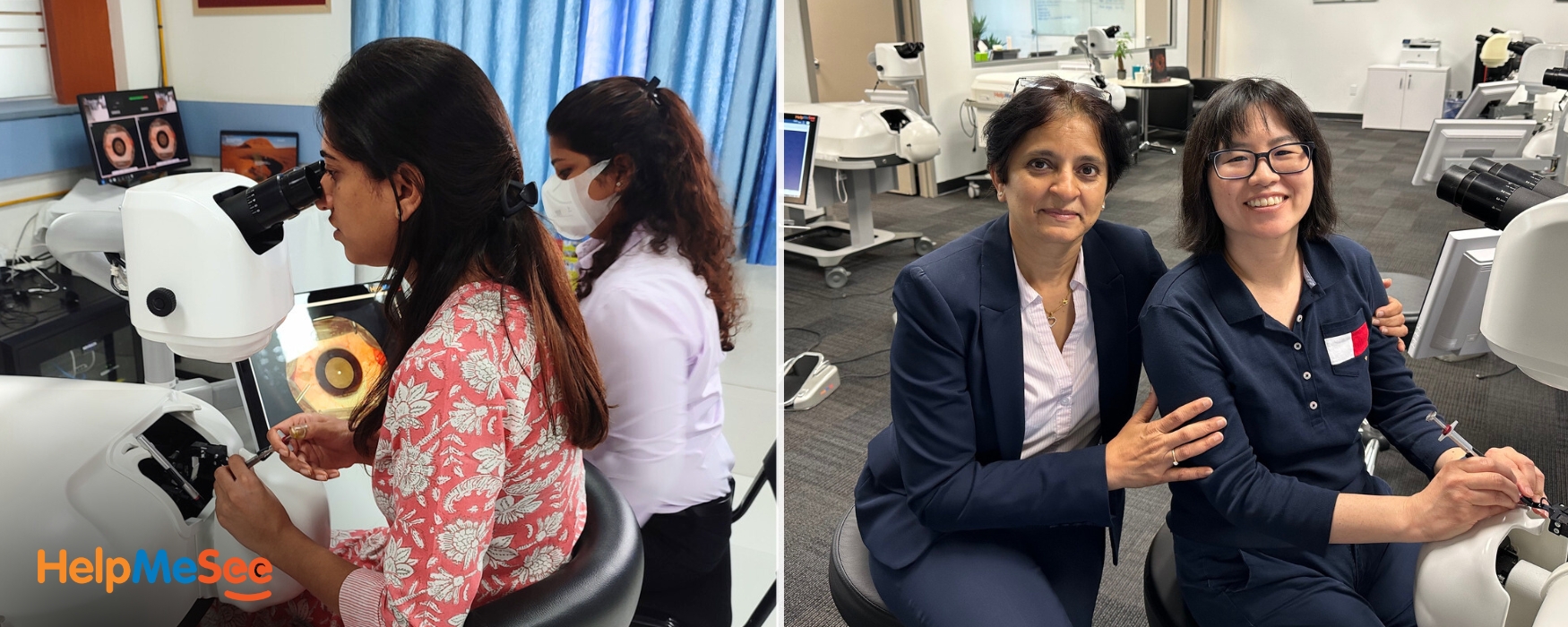
Ophthalmic procedure volume worldwide is increasing alongside the incidence of eye conditions and a broader focus on minimally invasive surgical techniques.1 This combination helps drive the adoption of myriad simulation-based training platforms across academic institutions, hospitals, and global health organizations. With respect to cataract surgery, there is an urgent need for more skilled surgeons, especially in regions where access to hands-on surgical exposure is limited, and simulators provide a scalable solution for training. HelpMeSee has been a consistent leader in simulation-based ophthalmic education, pioneering the use of high-fidelity, haptic virtual reality (VR) simulation to train surgeons in complex procedures such as Cirugía manual de catarata con incisión pequeña (MSICS), phacoemulsification cataract surgery, and now vitrectomy. As the market evolves, the HelpMeSee platform continues to align with and often anticipate key trends, including the following:- Immersive, lifelike visual environments built with advanced VR rendering.
- True haptic feedback that mimics the tactile feel of surgical instruments and ocular tissue response.
- Artificial intelligence (AI)-driven assessment tools that monitor trainee performance, identify errors, and guide surgeon growth.
- Scalable curriculum modules for a range of anterior segment procedures.
Market Forces
The explosion of virtual, augmented, and mixed reality is contributing to growth in simulation surgery platforms1 and defining what’s possible in surgical training. “A broad range of simulation systems in the market drives faster innovation by encouraging healthy competition, pushing companies to improve realism, usability, and cost-effectiveness,” Dr. Chavan said. As different simulators explore varied technologies, the best features quickly become shared expectations across the field. Let’s look at three market forces shaping 2026 and beyond.No. 1: Simulation technology is outpacing traditional training models.
High-fidelity surgery simulators can now replicate the nuanced tactile feedback of delicate ocular tissue manipulation, something no wet lab or plastic eye model can offer. According to an Allied Market Research report, the growing market for ophthalmic surgery training simulators is in response to increased demand for enhanced precision and a reduced risk of human errors.1 The HelpMeSee Eye Surgery simulator combines haptic micro-force feedback y immersive 3D environments to ensure trainees experience real-life conditions in a safe, repeatable setting. It also promotes a reduction in the volume of errors surgeons experience in their first 20 live cases.3,4 “Strong evidence that high-fidelity simulators help reduce complications and improve skill acquisition has accelerated institutional adoption worldwide,” Dr. Chavan said.No. 2: Across the simulator market, AI and data analytics are becoming a baseline requirement.
Trainees and educators want deep insights into skills acquisition, including data on instrument handling, decision-making, surgical efficiency, and complication avoidance. The HelpMeSee Simulation-based Training Program uses video recordings, data logs, and built-in analytics to track and analyze progression across every step of the cataract surgery procedure, creating hundreds of performance metrics that can be leveraged for objective feedback. This strategy, which helps trainees master an individual surgical step before progressing, has been shown to help them anticipate complications earlier in an operating room.2 It also supports operational consistency, evaluation, and even credentialing. “Simulator performance data will begin to play a stronger role in formal training milestones, making simulation a routine part of how surgeons are evaluated,” Dr. Chavan said. “Over time, these platforms will shift toward highly personalized learning, using detailed performance analytics to guide each trainee’s progress and highlight areas that need improvement.”No. 3: Portability and remote training are expanding global reach.
The shift toward portable, modular simulator platforms is making surgical education more accessible worldwide. As healthcare systems aim to upscale surgeons in underserved regions, portability has become a necessity. HelpMeSee continues to explore ways to extend simulation access through scalable deployments, including integration into regional training centers, traveling programs, and partnerships with academic centers, international nongovernmental organizations, ministries of health, and professional societies.
Evolving Consumer Needs
Eye care institutions as well as surgeon trainees seek simulation platforms that offer cost-effective deployment, a realistic surgical environment with customizable difficulty, objective performance tracking aligned with competency-based standards, and multi-procedure adaptability across anterior and posterior segment training. The HelpMeSee Eye Surgery Simulator was designed with these needs in mind, offering a comprehensive, scalable solution that supports trainees throughout their cataract surgical journey, from foundational instrument handling to complex procedural steps. “In my opinion, the main factor that has driven the growth of simulation-based training is the fact that it actually works,” Dr. Karla Pamela González Daher, a HelpMeSee instructor at Instituto Mexicano de Oftalmología (IMO) and head of the Anterior Segment Department, said. “Sometimes this is not easy to measure since residency training programs have different curricula.”Opportunities and Challenges Ahead
While the market outlook is overwhelmingly positive, challenges remain, including high implementation costs, inconsistent awareness in emerging regions, and regulatory considerations. The biggest current challenge, according to Dr. Gonzalez, is the surgical skills development curricula. “I think in the next decade, we will see a shift where residents must be certified in simulation before actually doing surgery in patients,” she said. Additionally, continued innovation combined with new deployment models will help make simulation-based training more accessible and cost-effective. “Rising investment across the broader medical-simulation sector is driving innovation while steadily lowering costs. Coupled with growing demand from low- and middle-income countries for scalable, portable training solutions—an area where HelpMeSee has been especially influential—the market continues to broaden and strengthen globally,” Dr. Chavan said.Conclusión
With rapid technological advancements, rising surgical demand, and an increasing global focus on competency, surgical simulation will continue to play a central role in preparing ophthalmologists for the future in 2026 and beyond.- Ophthalmic surgery training simulator market research, 2033. Allied Market Research. Accessed December 8, 2025. December 2024. https://www.alliedmarketresearch.com/ophthalmic-surgery-training-simulator-market-A324039
- Sankarananthan R, Prasad RS, Koshy TA, et al. An objective evaluation of simulated surgical outcomes among surgical trainees using manual small-incision cataract surgery virtual reality simulator. Indian J Ophthalmol. 2022;70:4018-25.
- Nair AG, Ahiwalay C, Bacchav AE, et al. Effectiveness of simulation-based training for manual small incision cataract surgery among novice surgeons: a randomized controlled trial. Sci Rep. 2021;11(1):10945.
- Lin JC, Yu Z, Scott IU, Greenberg PB. Virtual reality training for cataract surgery operating performance in ophthalmology trainees. Cochrane Database Syst Rev. 21 December 2021


 Spanish
  English
  French