

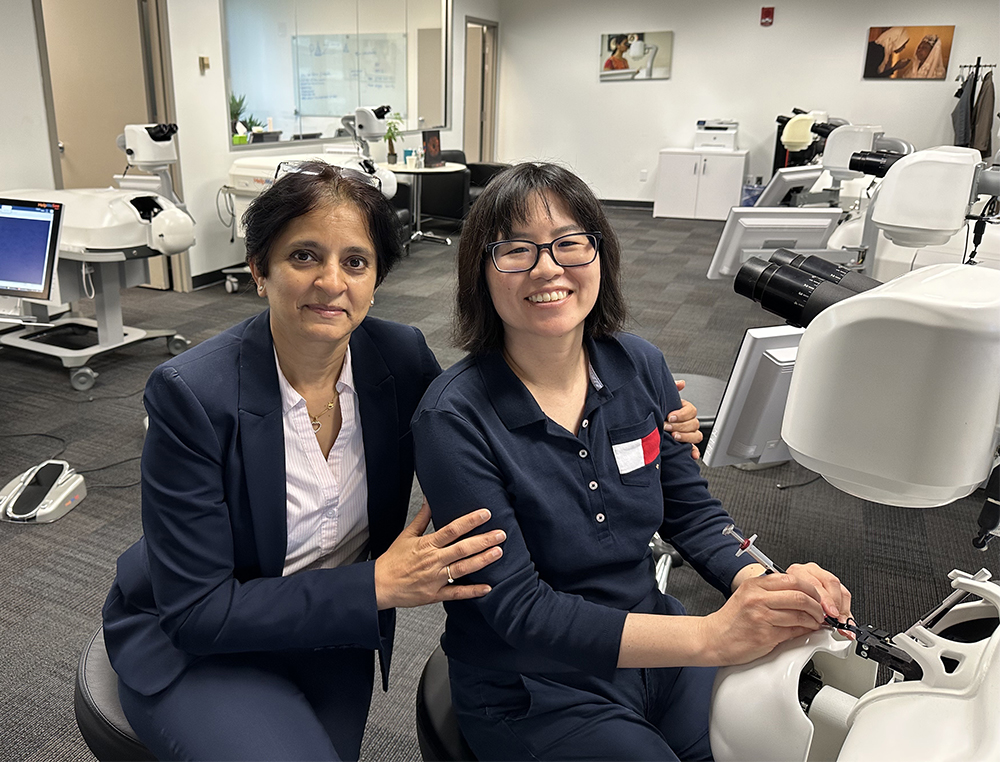
In ophthalmic education, few experiences are as immersive and transformative as simulation-based training, especially when it’s delivered with personal connection and expert guidance. At the Instituto Mexicano de Oftalmología (IMO) in Mexico, instructors Dr. Teresa Díaz and Dr. Karla Pamela González Daher have worked together for more than a decade. They see firsthand how the HelpMeSee Eye Surgery Simulator helps trainees develop critical surgical skills, overcome learning curve frustrations, and build confidence through personalized, hands-on instruction. Their role in the process is integral to helping trainees translate technical feedback into real-world surgical skills through encouragement, clarification, and hands-on support.

“The HelpMeSee program is not just about using a simulator. It’s about creating a human connection that helps trainees grow,” Dr. Díaz, lead clinical instructor, said, adding that the comprehensive training program focuses on providing surgical proficiency and decision-making skills through, not only repeated surgical simulation practice, but also instructor-led training courses. “My role is to support the other instructors, ensure clear communication with HelpMeSee, and most importantly, help our trainees reach their objectives.”
Dr. González, one of the program’s earliest instructors, plays a key role in implementing the HelpMeSee Eye Surgery Simulator curriculum at IMO. “Dr. Díaz and I have been working together on this program for a long time, and it’s been incredible to watch it evolve,” she said. “The course is intense—30 hours of simulation in a single week. Trainees often feel frustrated at the beginning, especially when they struggle to complete the exercises. But our job is to make sure they not only learn but also enjoy the experience.”
A dual emphasis on technical mastery and emotional support is one of the hallmarks of the HelpMeSee approach. While the simulator itself provides real-time performance analytics and precise feedback on surgical technique that has been shown to be an effective method to objectively evaluate the structural characteristics of the phases of cataract surgery and associated complications,[1] compassionate and patient coaching from the instructors helps trainees overcome early hurdles.
“We always remind them that it’s normal to feel challenged at first,” Dr. Díaz said. “The trainees might feel like they’re fighting with the simulator. But by the end of the week, they all improve. We see it every time.”
Dr. González agreed, adding that sharing personal experiences helps normalize the learning curve. “When the simulators first arrived, even as experienced surgeons, we couldn’t make a single satisfactory attempt at first. That story helps trainees realize they’re not alone. Even we had to adjust to the simulator.”

Another unique aspect of the program is its emphasis on peer learning and team-based encouragement. Each training cohort typically includes three to six participants, with two trainees sharing each simulator. This setup creates opportunities for camaraderie and collaboration and learning from each other by observing and commenting.
“It’s very motivating when they help each other,” Dr. “We see a lot of teamwork and hear comments like, ‘Try moving your hand this way,’ or ‘I did it like this and it worked.’ They build each other up.”
A peer dynamic is especially powerful given the diversity in each group. “You might have a first-year resident training alongside an ophthalmologist with years of experience,” Dr. González said. “It’s impressive to see how much they learn from each other. They’re not just taking instruction from us, they’re problem-solving together.”
The learning environment itself also plays a key role in the program’s success, with studies indicating that controlled, effective, and well-supervised learning environments may significantly impact the educational efforts.[2] The instructors are deliberate about maintaining a relaxed, supportive atmosphere where mistakes are part of the process. “Sometimes, we make mistakes while demonstrating something,” Dr. González said. “That shows the trainees we’re all human. They see that even instructors aren’t perfect, and that puts them at ease.”
Of course, the simulator’s built-in analytics are a vital component of the learning experience. Every attempt is evaluated against specific criteria such as the length, location, and depth of an incision and marked as satisfactory or unsatisfactory. These objective metrics provide a structured path for improvement.
“The analytics help trainees understand exactly why an attempt didn’t meet the standard,” Dra. Díaz explained. “They can see that they entered the anterior chamber too deeply or didn’t fill the capsular bag with the right volume of ophthalmic viscosurgical device (OVD). That feedback helps them refine their technique on the next attempt.”
At the same time, the instructors are careful to contextualize the simulator’s rigid parameters. “Sometimes, a score is marked unsatisfactory for a measurement that would still be acceptable in real surgery,” Dr. González added. “That’s where we come in, to help them understand the difference between what the simulator sees and what they might encounter in a patient.”

Ultimately, what sets HelpMeSee’s program apart is the personalized nature of the instruction and the commitment to building relationships between trainers and trainees. It’s not a one-size-fits-all curriculum but an experience that adapts to the learner’s pace, mindset, and skill level.
“It’s very different from other training platforms,” Dr. Díaz said. “We’re not just watching them practice. We’re coaching them through every step. We celebrate their progress, help them through frustration, and remind them that growth takes time.”
For trainees, the result is a learning experience that’s not only technically sound but deeply human. And for Dr. González and Dr. Díaz, that’s what makes their work so meaningful.
“We’re not just teaching surgery,” Dr. González concluded. “We’re helping them believe in themselves.”
- Sankarananthan R, Senthil Prasad R, Koshy TA, et al. An objective evaluation of simulated surgical outcomes among surgical trainees using manual small-incision cataract surgery virtual reality simulator. Ind J Ophthalmol. 2022;70:4018-4020.
- Lansingh VC, González Daher P, Flores TD, et al. How many cataract surgeries does it take to be a good surgeon? Revista Mexicana de Oftalmología (ENG). 2023;97(2):33-34.
-


 Spanish
  English
  French