

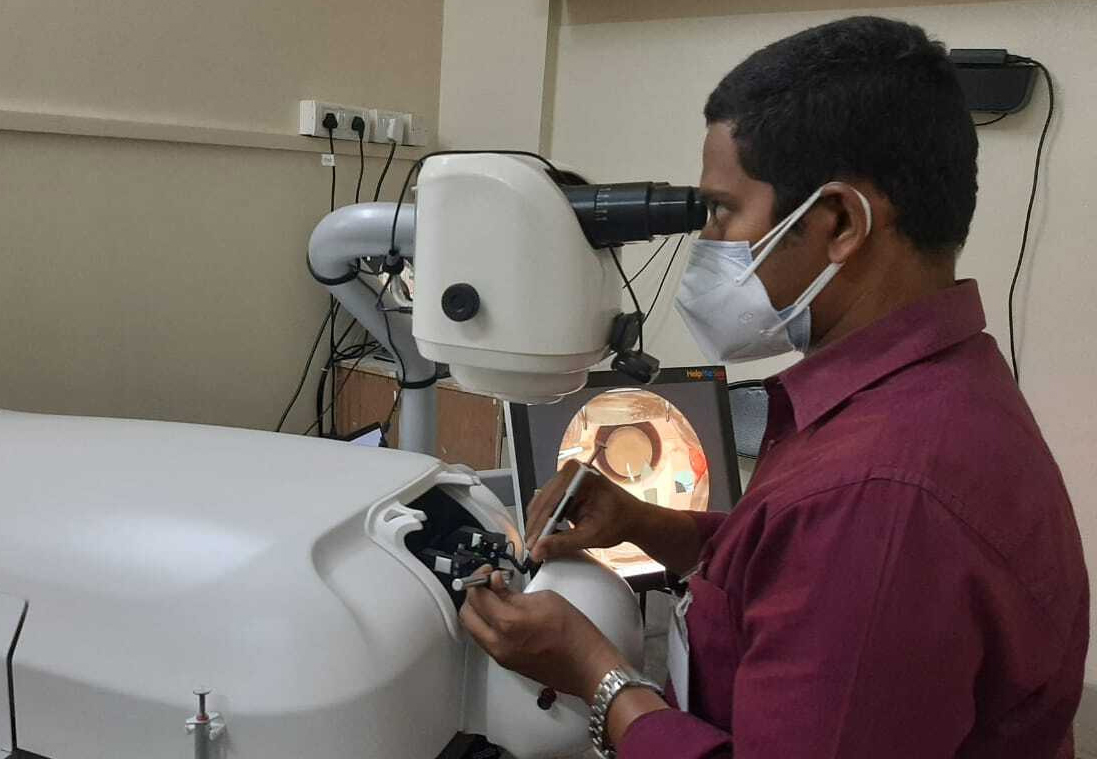
Wetlabs have been a cornerstone of ophthalmology training for decades, allowing trainees to practice the delicate techniques of cataract surgery on animal eyes or synthetic models in a safe and controlled setting. Although they provide an important opportunity to hone a trainee’s dexterity before ever entering the operating room, wetlabs lack the tactile and haptic feedback needed to truly replicate live surgery, and they do not support unlimited, structured practice.
Virtual reality (VR) simulation bridges these gaps, offering trainees lifelike and scalable surgical experiences that grow their skillset and surgical confidence.

Benefits of Digital Learning
The next generation of ophthalmologists has grown up with digital learning at their fingertips. Online lectures and webinars, surgical video libraries, and even the rise of virtual conferences during the COVID-19 pandemic have made education more accessible than ever. As a result, today’s ophthalmology residents and fellows expect flexible, interactive, and immersive training resources that go beyond the traditional teaching model, which leverages wetlab training and an apprenticeship model in which trainees are ushered through didactics, surgical observation, and perfecting individual surgical steps before completing a live surgical case on their own.
The use of VR training is growing. One major benefit is that VR simulation allows residents and fellows to practice surgery in a controlled and effective learning environment. It brings together the precision of surgical simulation with the accessibility of digital platforms. Unlike a wetlab, VR simulation provides the following:
No 1: Repetition without limitation. Cataract surgeons can practice procedural steps endlessly without the need for consumables.
No 2: Standardized learning. Every trainee receives consistent and structured practice opportunities.
No. 3: Realistic feedback. Advanced software replicates the feel and flow of real surgery.
No. 4: Real-time performance analytics. Individualized data provide trainees with tailored feedback that helps them progress from a beginner to a confident surgeon at their own pace and ability level.
With the HelpMeSee Cataract Surgery Simulation-based Training Program specifically, each step of the procedure is tracked and analyzed through detailed data logs and video recordings. This provides objective feedback that helps trainees master each step of the procedure before transitioning to live surgery. In one study, a VR manual small incision cataract surgery simulation model was used to objectively evaluate the structural steps of the procedure and their associated complications. A recent study observed that, with repeated practice, trainees achieved higher scores and experienced fewer complications, showing how simulation training may accelerate skills acquisition and help surgeons anticipate potential complications earlier in the operating room.(1)
Although VR has not yet replaced the use of wetlabs, it has emerged as a powerful complementary tool that helps trainees master core techniques before moving to live surgery. The result is more confident, better-prepared surgeons, which has been supported by studies showing that simulation may reduce the number of errors trainees make in the first 20 live procedures they perform. (2) Ultimately, this supports safer patient outcomes.

Experience the Future
Not all VR simulators are equal. An immersive VR simulation model that marries digital precision with instructor-led training is poised to enhance skills acquisition and proficiency assessment.
The groundbreaking HelpMeSee Simulation-based Training Program is a game-changer in the field of cataract surgery simulation training. Its advanced features and lifelike simulations make it an invaluable tool for surgeons looking to enhance their skills in a safe and controlled environment.
Although feedback is integral to a trainee’s development of technical skills, subjective verbal feedback from an instructor supports the retainment of skills.4 The HelpMeSee Simulation-based Training Program provides a two-way feedback system that combines objective feedback from the simulation device with the subjective feedback from an instructor to encourage the development of not only a precise surgical technique but also mental and emotional surgical context.
HelpMeSee is also a scalable resource that can be used in both high-income and low-income countries This universal access to a high-quality surgical training program is key to solving the global cataract blindness crisis. Our innovative simulation-based curriculum is designed to prepare trainees efficiently, safely, and effectively. This transforms how surgical education is delivered worldwide.
As simulation-based and VR training continue to evolve, incorporating these tools into surgical education can help ensure future ophthalmologists are equipped with the skills and confidence needed to deliver the highest quality care.
- Sankarananthan R, Prasad RS, Koshy TA, et al. An objective evaluation of simulated surgical outcomes among surgical trainees using manual small-incision cataract surgery virtual reality simulator. Indian J Ophthalmol. 2022;70:4018-25.
- Nair AG, Ahiwalay C, Bacchav AE, et al. Effectiveness of simulation-based training for manual small incision cataract surgery among novice surgeons: a randomized controlled trial. Sci Rep. 2021;11(1):10945.
- Lin JC, Yu Z, Scott IU, Greenberg PB. Virtual reality training for cataract surgery operating performance in ophthalmology trainees. Cochrane Database Syst Rev.
- Porte MC, e al. Verbal feedback from an expert is more effective than self-accessed feedback about motion efficiency in learning new surgical skills. Am J Surg. 2007;193(1):105-110.


 Spanish
  English
  French