

Cataracts remain the leading cause of blindness worldwide, particularly in low- and middle-income countries (LMICs). By 2050, the global cataract burden is projected to rise significantly, driven by aging populations and insufficient surgical capacity in many regions.
The urgency is clear: the current surgical workforce is not keeping pace with surgical demand. Without a larger pool of trained cataract surgeons and access to practical techniques like Manual Small Incision Cataract Surgery (MSICS), millions will continue to suffer preventable blindness. While advanced procedures such as phacoemulsification are effective, they are often impractical in many parts of the world due to high equipment costs. In contrast, MSICS delivers comparable outcomes without dependence on costly technology. (1)
MSICS provides health systems with a flexible and cost-effective surgical solution. It accommodates diverse clinical settings, requires minimal equipment, and can be efficiently taught through structured programs. With the advent of simulation-based education, cataract specialists can now master MSICS skills more quickly and safely, regardless of their location.
Ultimately, the goal is not just to increase surgical volume; it’s to expand access, improve equity, and deliver better outcomes for people experiencing cataract blindness or vision impairment.

Why MSICS Still Matters
MSICS is uniquely equipped to meet the demands of global eye care. It is fast, safe, and scalable—an essential advantage in areas with high cataract prevalence and limited resources. Its versatility has made it a cornerstone of outreach programs and mobile surgical units. (2)
Despite advances in technology, global health authorities continue to emphasize the importance of manual techniques like MSICS in both resource-rich and resource-limited environments. MSICS is not simply a fallback, it is often the preferred approach where high-volume, low-cost care is essential. (2)
However, today’s cataract care depends on a global community of highly skilled cataract specialists and ophthalmologists, but there are not nearly enough of them. The shortage is most severe in regions with the highest burden of blindness. In many countries, there are fewer than one ophthalmologist per 100,000 people. Even where services exist, long wait times and limited access prevent patients from receiving care when it’s most effective.
Building this workforce starts with training and that training must be practical, scalable, and safe.
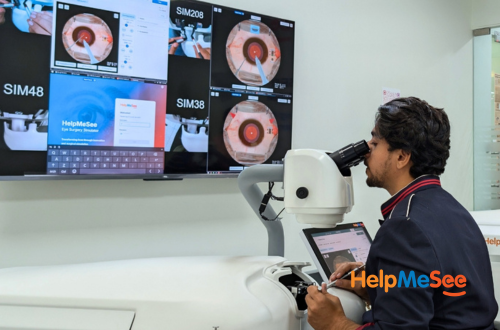
Programs like the HelpMeSee Simulation-based Training Program offers an similar experience live surgery, allowing for the scalable training of large numbers of cataract specialists. The program builds transferable competency and reduces cataract surgery training time. The ophthalmology simulation-based courses allow cataract specialists to practice surgery and learn to address complications through simulation, rather than initially on live patients and their actual eyes.
Virtual reality (VR) platforms with programs like the HelpMeSee Simulation-based Training Program are transforming how cataract specialists are trained with instructor-led curriculum. Cataract specialists and ophthalmologists can practice hundreds of procedures with real-time feedback, objective performance data, and zero risk to patients. This ensures that by the time they perform live surgery, they already have the muscle memory, decision-making, and confidence needed to deliver safe outcomes. (2)
A recent study in the BMC Medical Education journal confirms that these tools boost proficiency, shorten learning curves, and improve complication management especially for MSICS. (3)

MSICS is the Right Skill for the Right Time
Research shows that VR simulation improves surgical performance in both MSICS y phacoemulsification. Notably, training outcomes were comparable whether simulation was led by expert cataract specialists or non-ophthalmologist instructors (1). This makes it possible to scale training rapidly using near-peer instruction models.
Haptic feedback—realistic tactile responses embedded in simulators—also plays a crucial role in helping trainees develop the fine motor skills required for delicate procedures like MSICS. (2)
Simulation-based training expands the cataract surgery workforce, accelerates deployment in high-need regions, and enhances surgical safety. It bridges the gap between rising demand and limited resources and brings quality MSICS training to thousands who might never have had access to traditional operating room instruction.
As surgical needs grow and disparities deepen, MSICS offers a practical way forward. It’s a skill that adapts to limitations and keeps delivering results. With modern training tools like VR-based simulation, we can prepare the next generation of cataract specialists to meet global needs—effectively, safely, and at scale.
- Ye Z, He SZ, Li ZH. Efficacy comparison between manual small incision cataract surgery and phacoemulsification in cataract patients: a meta-analysis. Int J Clin Exp Med. 2015 Jun 15;8(6):8848-53. PMID: 26309538; PMCID: PMC4538015.
- Nair, AG., et al. “Assessment of a high-fidelity, virtual reality-based, manual small-incision cataract surgery simulator.” Indian Journal of Ophthalmology 2022;70(11):4010-4015. [DOI:10.4103/ijo.IJO_1593_22]
- Bozkurt Oflaz, Ayse, et al. “Fine motor and sensory proficiency: implications for simulator-based surgical assessments.” BMC Medical Education 2025;25:1184. [DOI:10.1186/s12909-025-07783-7]


 Spanish
  English
  French