

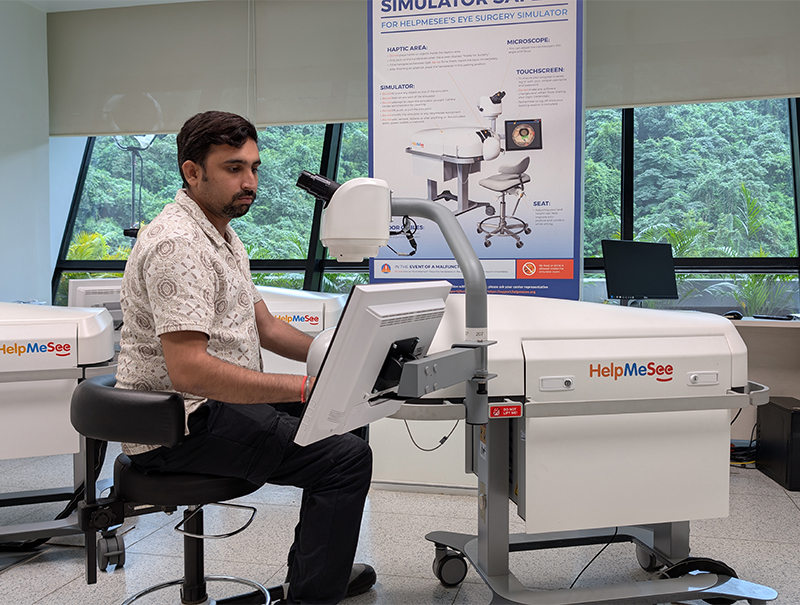
When it comes to cataract surgery, one principle is clear: the quality of training directly impacts patient outcomes. Yet across the globe, cataract surgeons receive vastly different levels of preparation including using newer technology tools such as simulation-based training. While some ophthalmic professionals undergo years of structured, supervised training, others receive partial and insufficient training limiting their proficiency. In low- and middle-income countries, training often relies on passive observation and supervised completing different steps during live surgeries.
This disparity raises a critical question: Should ophthalmic surgical training be standardized globally? (1)

The Global Cataract Burden—and the Education Divide
Cataract remains the leading cause of blindness worldwide and the second cause of moderate or severe vision loss affecting over 100 million people. The greatest burden lies in South Asia and sub-Saharan Africa—regions where access to surgical care is often limited (2). By 2050, the global demand for cataract surgery will skyrocket due to population aging and growth, and the number of cases is expected to more than double globally, placing a significant strain on healthcare systems and eye care professionals.
One of the greatest obstacles to addressing this crisis is the shortage of adequately trained cataract surgeons. Cirugía manual de catarata con incisión pequeña (MSICS) is a highly effective treatment in resource-limited settings due to its affordability and efficiency (3). Performing successful MSICS as a cataract surgeon requires more than good will, but attention toward a comprehensive and strcutured hands-on training approach.
Unfortunately, global training opportunities remain inconsistent. A recent review of U.S. residency programs found that only 25% publicly offer global surgical electives—and most are brief, unstructured experiences (4).
This lack of standardized, competency-based education puts patients at significant risk.

Simulation-based Surgical Training: A Proven Solution
Simulation-based surgical training, especially when powered by virtual reality (VR) and haptic feedback, offers a transformative solution.
Multiple studies confirm that simulation-trained cataract specialists outperform their traditionally trained peers. One study demonstrated a significant reduction in posterior capsule rupture rates among novice surgeons who trained using VR simulators (5). Another randomized controlled trial revealed that even non-ophthalmologist instructors could teach MSICS effectively using simulation, proving that structured, simulator-based training is scalable and reproducible (6).
A global survey found that 25 training centers across 26 countries required simulation proficiency before allowing trainees to operate on actual patients. In these centers, simulation was viewed not as a luxury but as a surgical prerequisite (5).
Why Real-Time Feedback Matters
In traditional models, surgical feedback is often realized instantly if they applied too much force, missed their incision depth, or tore the capsule. Turning to supplement some of the live surgery training with simulation-based training powered by haptic (motor sensory) technology offers immediate feedback in a similar way without patient risk.
This real-time correction accelerates the learning curve and enhances fine-motor development which is a critical advantage when training for precision-based tasks like cataract surgery. A 2025 study found a direct link between motor-sensory acuity and surgical proficiency, further validating the use of simulation for skill development (7).
Instructor-led simulation programs such as the HelpMeSee Simulation-based Training Program enhance this benefit by providing personalized guidance, progress tracking, and objective assessments, all within a safe, risk-free environment (8).
What Would a Global Standard Look Like?
Global standardization doesn’t require identical tools or timelines. It means setting universal, competency-based benchmarks. Key elements might include:
- Mandatory demonstration of simulator-based proficiency before performing live MSICS or phacoemulsification.
- Universal access to high-fidelity simulation for both motor skills and decision-making.
- Structured, instructor-led feedback as a core component of training.
Countries with advanced simulation infrastructure, such as Denmark and England, require simulation-based learning before entering in the operating room and lead the initiative of incorporating simulation-based learning into residencies. Through global partnerships, perhaps even resource-limited regions can gain access to this quality training.
One critical yet often overlooked benefit of simulation is exposure to serious intraoperative complications. Posterior capsule rupture, vitreous loss, and other complications require immediate and appropriate responses. Simulation allows trainees to repeatedly practice these high-stakes scenarios, building the mental and motor memory needed to succeed under pressure.

Creating an Equitable Future in Eye Care
Today’s inconsistencies in ophthalmology training reflect deeper inequities in global healthcare. While residents in every training center could benefit from VR simulators and structured supervision, those centers and universities in higher resource settings have greater potential to gain access to simulation-based technology than those in low-resource settings which often learn through limited observation and supervision.
Simulation-based training can help level this playing field. It ensures that no matter where a cataract surgeon is trained, they meet the same standard of surgical readiness. Adoption timelines may vary, but the goal remains the same: safer, more equitable global cataract care.
Moving to Standardization
Standardizing ophthalmology training, especially through simulation-based training, is a granted cure for global blindness, and is powerful, scalable, and proven step in the right direction.
Simulation-based education improves outcomes, reduces complications, and shortens the path to surgical confidence. It enables global benchmarks where readiness, not geography, defines surgical competence.
To eliminate avoidable blindness by 2050, the path forward is clear: embrace a structured, validated, and universally accessible approach to surgical education.
- Competency-based European training requirements for the specialty of ophthalmology. Recommendations from the UEMS section of ophthalmology and the European Board of Ophthalmology. Filipe HP, Yaïci R, Ivekovic R, Curtin D, Asoklis R, Atilla H, Bak E, Pueyo-Bestué A, Beaconsfield M, Creuzot-Garcher C, Cvenkel B, Flanagan L, Imhof S, Kivelä T, Koppen C, Mrukwa-Kominec E, Maino A, Mouriaux F, Muselier A, Dhubghaill SN, Paust K, Priglinger S, Stopa M, Strong B, Tanner F, Tassignon MJ, Ursell P; ETR Subspecialties Working Group; Aclimandos W, Bourcier T. Acta Ophthalmol. 2025 Aug 7. doi: 10.1111/aos.17575. Online ahead of print. PMID: 40772599
- Jiang, Xiaohui, et al. Global trends in cataract burden: a 30-year epidemiological analysis and prediction of 2050 from the Global Burden of Disease 2021 study. Br J Ophthalmol, 2025.
- Publisher Correction: Global estimates on the number of people blind or visually impaired by cataract: a meta-analysis from 2000 to 2020. Vision Loss Expert Group of the Global Burden of Disease Study; GBD 2019 Blindness and Vision Impairment Collaborators. Eye (Lond). 2024 Aug;38(11):2229-2231. doi: 10.1038/s41433-024-03161-7. PMID: 39014211 Free PMC article. No abstract available.
- Shalini Shah, MD, Chris R. Alabiad, MD, Zubair Ansari, MD. “A Web-based Review of Global Training in United States Ophthalmology Residency Programs.” Association of University Professors of Ophthalmology, 2025.
- Dormegny, Lea, et al. “Global Trends and Practice Patterns in Virtual Reality Simulation Training for Ophthalmic Surgery.” Scientific Reports, vol. 15, 2025, article 30886.
- Boberg-Ans, Lars Christian, et al. “Comparing the Impact of Surgical Expert versus Non-Ophthalmologist Instructors on Virtual-Reality Surgical Performance: A Randomized Controlled Trial.” Acta Ophthalmologica, vol. 102, no. 8, 2024, pp. 906–913. Wiley Online Library, https://doi.org/10.1111/aos.16719.
- Bozkurt Oflaz, Ayse, et al. “Fine Motor and Sensory Proficiency: Implications for Simulator-Based Surgical Assessments.” BMC Medical Education, vol. 25, 2025, article 1184.
- Abdulnour, Raja-Elie E., et al. “Educational Strategies for Clinical Supervision of Artificial Intelligence Use.” The New England Journal of Medicine, vol. 393, no. 8, 2025, pp. 786–797.


 Spanish
  English
  French