

By Laura Straub
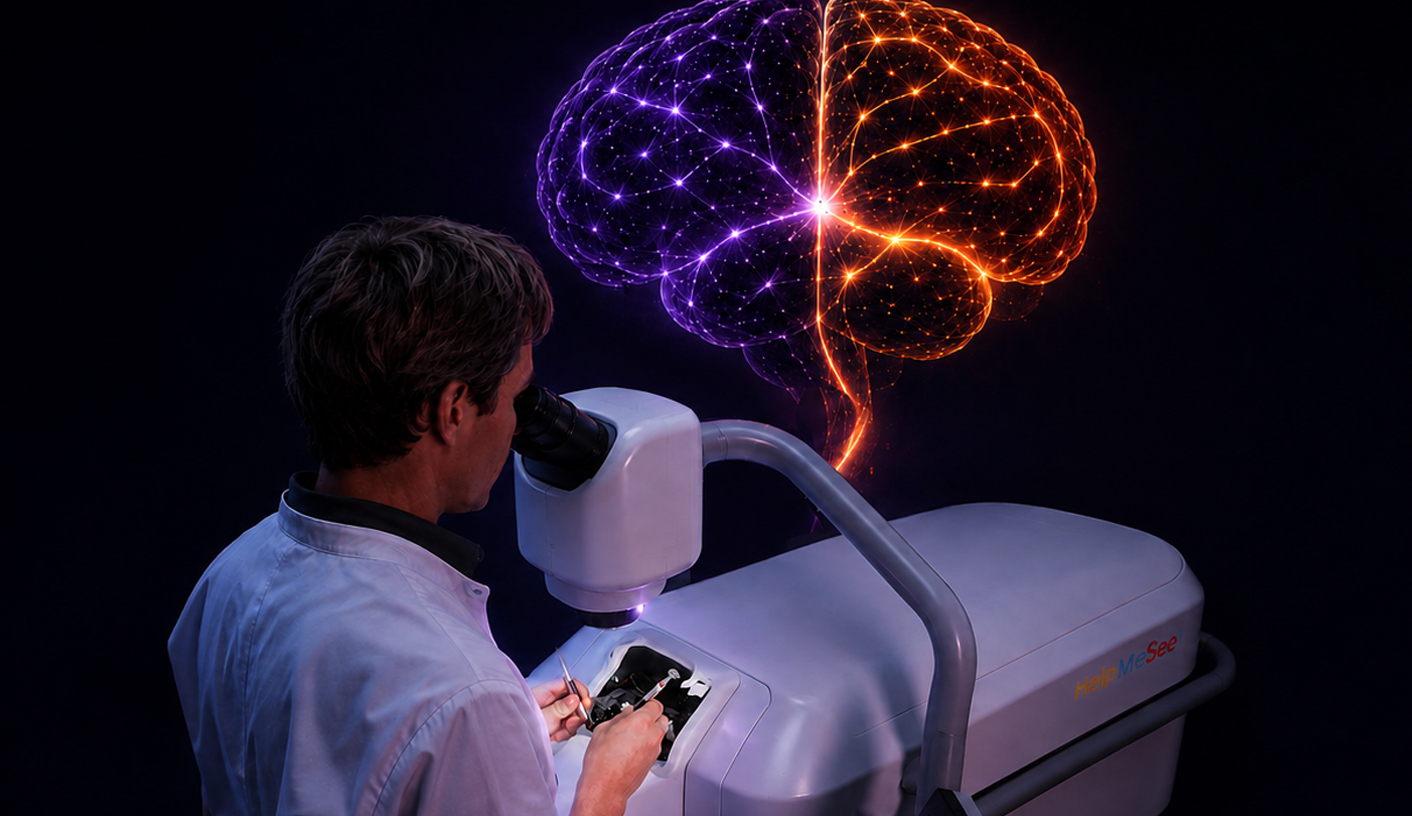
Picture the first time you created a clear corneal incision, a capsulorrhexis, or inserted an IOL into the anterior chamber. Your hands weren’t steady. Your movements weren’t efficient. You had to consciously think through every micro-motion. Now, picture yourself doing it today. Chances are your movements are smooth, automatic, and almost thoughtless. What changed wasn’t just your confidence. It was your brain.
Repetition creates a quiet neurological transformation. Performing a new motor task causes the brain to fire a specific sequence of neurons that support hand-eye coordination.1 The first time, the signal travels along a thin, unreliable pathway, like a footpath through tall grass. With each sequential effort of that exact motion, the neurons strengthen their connections as a fatty substance called myelin begins to wrap around the nerve fibers carrying the signal.2,3 Myelin acts like insulation on an electrical wire, helping the signal travel faster and more efficiently. Neuroscientists sometimes describe this process as a footpath becoming a highway.4
THREE STAGES OF BRAIN COGNITION
The brain moves through a series of physical and cognitive stages as a skill shift from conscious, clumsy effort to unconscious, fluent execution.5
Stage 1: Cognitive. The brain processes every step as it builds the skill. Improvement is slow, and errors are frequent.
Stage 2: Associative. The movements start linking together. In this stage, the brain requires less conscious thought, promoting fewer and less significant errors.
Stage 3: Autonomous. At this point, the skill becomes second nature. The hands know what to do before the conscious mind has finished the thought.
Getting from stage one to stage three is less about talent and more about the volume and quality of repetition. For this reason, simulation-based training is invaluable in modern surgical education and the foundation of how HelpMeSee designs its training programs.
PRACTICE MUST BE DELIBERATE
Here’s the twist: Simply doing something repeatedly doesn’t guarantee improvement. Deliberate practice, a framework pioneered by psychologist K. Anders Ericsson, is also required to rewire the brain.6 Essential components of deliberate practice include setting a specific goal, obtaining immediate feedback, and calibrating a task just beyond your current comfort zone. This pushes you to notice your errors in real time, correct them immediately, and try again to build stronger, more accurate neural pathways with each cycle.
A well-designed simulator makes deliberate practice possible. Unlike learning in a live operating room, where mistakes carry real consequences and feedback is often delayed or filtered through an attending’s verbal correction, simulation allows trainees to repeat a maneuver dozens or hundreds of times in a single session while receiving instant, objective feedback on precision, technique, and instrument handling.7-10 Trainees can fail safely and immediately try again, without risk to a patient, and they progressively increase difficulty of surgical maneuvers as their competence builds. Each repetition paired with immediate feedback is a small deposit into the myelin bank account around the neural circuits that will one day lead to the ability to perform flawless, sight-restoring surgery.
WHERE THE SCIENCE MEETS THE MISSION
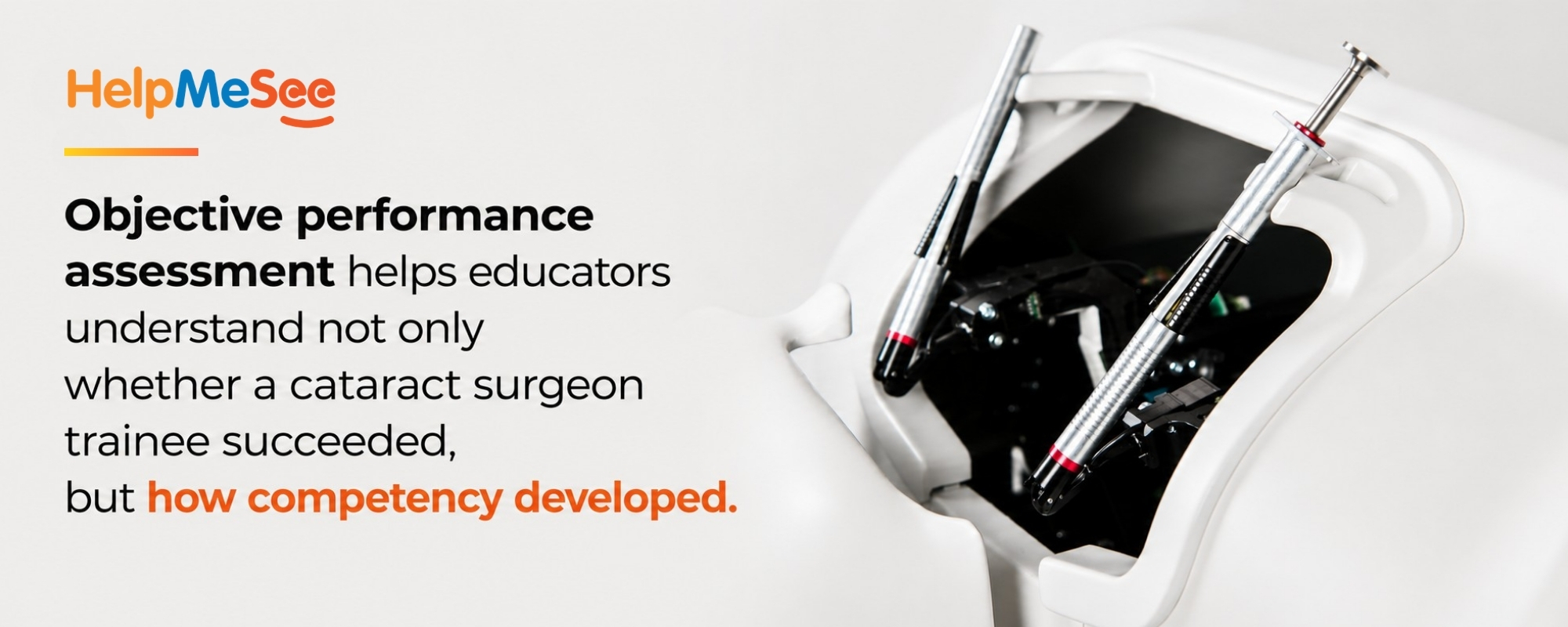
The HelpMeSee Eye Surgery Simulator curriculum, lead by an experienced instructor, was built from the ground up around the science of motor learning with the aim to train future generations of cataract surgeons. It gives trainees the structured, high-repetition, feedback-rich environment their brains need to move efficiently from the cognitive to the autonomous stage of brain cognition.
Cataracts remain the leading cause of preventable blindness and visual impairment globally, disproportionately affecting communities with limited access to surgical care.,11 Every ophthalmologist who trains with HelpMeSee and builds durable, myelinated neural pathways becomes capable of performing safe, high-quality, high-volume surgery, multiplying the number of patients who regain their sight in underserved regions around the world.
Training on a HelpMeSee Eye Surgery Simulator helps build the neural infrastructure required for operating with speed, precision, and confidence. Science is clear, skilled hands are developed one deliberate repetition at a time. HelpMeSee has built its entire training mission around this concept.
Interested in learning more about HelpMeSee simulation-based training programs? Explore our training opportunities and discover how you can help end needless blindness from cataracts.
Laura Straub is a medical communications strategist and writer. Reach her at [email protected].
REFERENCES
- Wolpert DM, Diedrichsen J, Flanagan JR. Principles of sensimotor learning. Nat Rev Neurosci. 2011;12(12):739-751.
- McKenzie IA, Ohayon D, Li H, Paes de Faria J, Emery B, Tohyama K, Richardson WD. Motor skill learning requires active central myelination. 2014;346(6207):318-322.
- Bengtsson SL, Nagy Z, Skare S, Forsman L, Forssberg H, Ullén, F. Extensive piano practicing has regionally specific effects on white matter development. Nat Neurosci. 2005;8(9):1148-1150.
- Fields RD. White matter in learning, cognition and psychiatric disorders. Trends Neurosci. 2008;31(7):361-370.
- Fitts PM, Posner MI. Human Performance. Brooks/Cole Publishing Company. 1967.
- Ericsson KA, Krampe RT, Tesch-Romer C. The role of deliberate practice in the acquisition of expert performance. Psychol Review. 1993;100(3):363-406.
- Sankarananthan R, Prasad RS, Koshy TA, et al. An objective evaluation of simulated surgical outcomes among surgical trainees using manual small-incision cataract surgery virtual reality simulator. Indian J Ophthalmol. 2022;70:4018-25.
- Porte MC, e al. Verbal feedback from an expert is more effective than self-accessed feedback about motion efficiency in learning new surgical skills. Am J Surg. 2007;193(1):105-110.
- Nair AG, Ahiwalay C, Bacchav AE, et al. Effectiveness of simulation-based training for manual small incision cataract surgery among novice surgeons: a randomized controlled trial. Sci Rep. 2021;11(1):10945.
- Lin JC, Yu Z, Scott IU, Greenberg PB. Virtual reality training for cataract surgery operating performance in ophthalmology trainees. Cochrane Database Syst Rev.
- International Agency for the Prevention of Blindness. 1.1 billion people live with vision loss. Accessed July 7, 2026. https://www.iapb.org/learn/vision-atlas/


 French
  English
  Spanish