

By Laura Straub
According to statistics released earlier this year, cataract remains the leading cause of blindness worldwide. More than 15.2 million people are blind from cataract and another 78.8 million have moderate to severe visual impairment. (1) The burden is only growing. Between 1990 and 2021, there was a 91.8% increase in the global years lived with disability due to cataracts (3.42 to 6.55 million). (2) Population growth and aging are part of the story, but so is an unevenly distributed surgical workforce. High-income countries average 76.2 ophthalmologists per million people compared to just 3.7 per million in low-income countries. (3)
For decades, the conversation about surgical capacity in low-resource settings focused on this and other numbers, including the number of available operating rooms and patients on waiting lists. Capacity, however, is not the only gap in cataract care. A trainee in a rural clinic and a trainee in a metropolitan teaching hospital have real differences in available equipment, staffing ratios, and follow-up infrastructure, translating to vastly different surgical instructional experiences.
Reducing the gap in cataract blindness requires progress on two fronts at once. The first is straightforward: training more surgeons, faster, in the places that need them most. The second is less visible but just as crucial: common training curricula, shared competency benchmarks, and a standardized way of measuring surgical outcomes across many different settings. A rural clinic and a metropolitan teaching hospital can both produce skilled surgeons, but only if the term skilled means the same thing in both places. HelpMeSee believes collaborative research and cross-institutional partnership are some of the greatest innovations needed to advance both fronts of cataract surgery training globally.
MSICS Has Applications in Any Setting
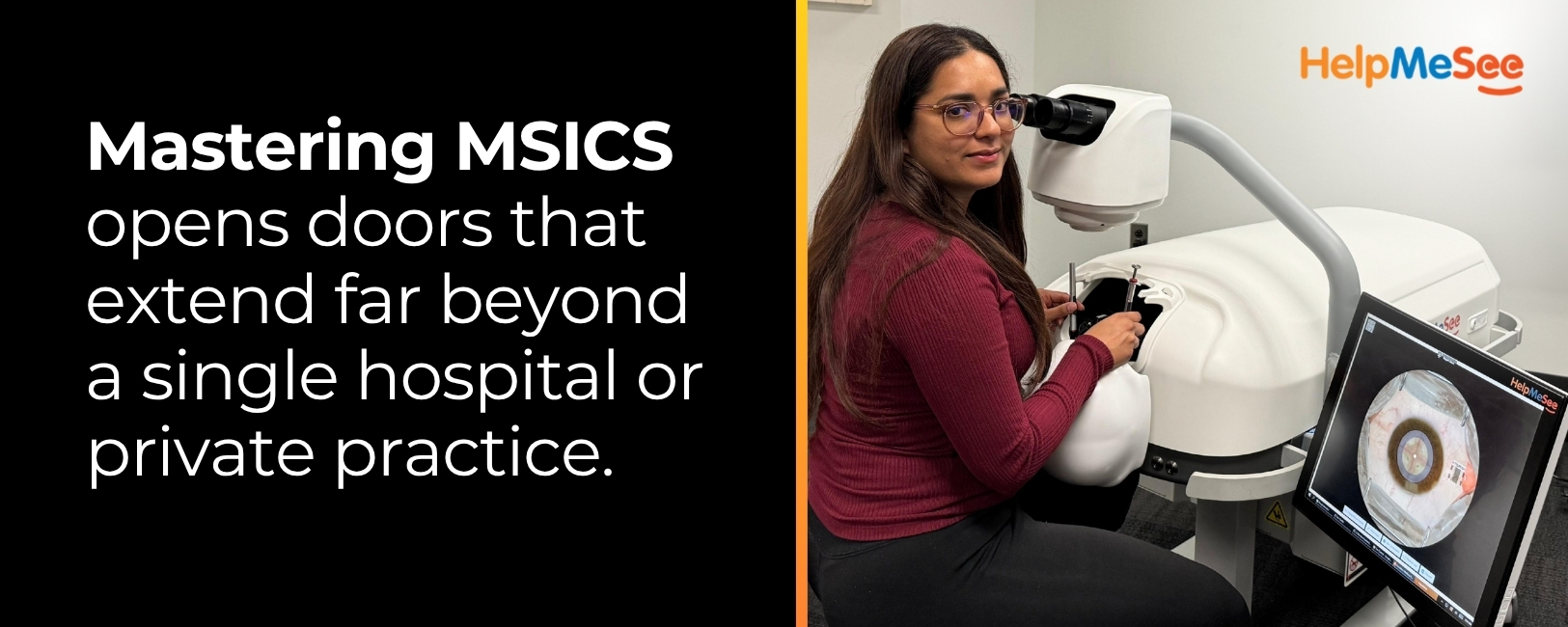
Chirurgie de la cataracte par petite incision manuelle (MSICS) is often considered a lower-cost alternative to phacoemulsification when ultrasound-based phaco equipment isn’t available. It doesn’t require a large capital investment, a reliable power infrastructure besides the microscope, or the consumables that phacoemulsification depends on. Therefore, MSICS is a practical primary technique rather than a fallback in many parts of the world. (4)
“Manual small incision cataract surgery (MSICS) has become the surgery of choice in developing countries and setups with a high cataract load,” Charmi Hareshkumar Madhani, MD, and colleagues wrote. (5)
Applications for MSICS extend beyond these settings, however. For example, it may be helpful at any time the use of high ultrasound energy risks severe corneal endothelial damage such as in the case of hard, mature, and brunescent cataracts. It also has advantages in eyes with weak or compromised zonules and poor red reflex.
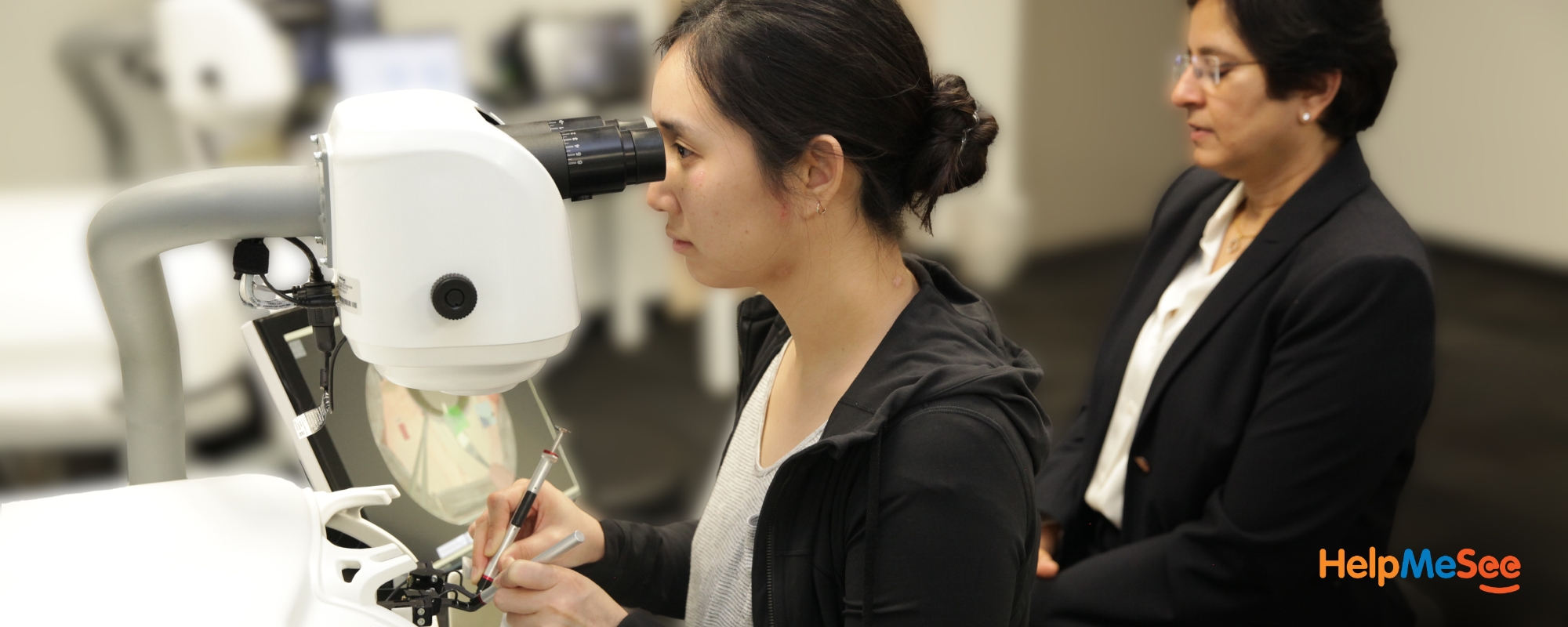
Le HelpMeSee simulation-based approach to MSICS training lets individuals rehearse the MSICS procedure, from the scleral tunnel and capsulorhexis through nucleus delivery and IOL insertion, over dozens of hours of guided repetition on a virtual reality simulator before ever treating a live patient. Without simulation, that kind of repeatable, standardized practice is hard to deliver, especially in regions where there aren’t enough experienced surgeons to individualize mentor-led training. The results of virtual reality simulation surgery not only reduce surgical errors but also build the muscle memory and confidence surgeons need before their first live case. In one study, surgical errors decreased up to 50% when trainees completed simulation-based training before operating on live patients. (6)
Consistency matters beyond the operating room, too. A 2026 study assessing the HelpMeSee MSICS course found “overall scores increased significantly from novice residents to expert ophthalmic surgeons,” a finding that speaks directly to the kind of standardized benchmarking the field has long lacked. (7) A simulator that can measure where a trainee stands while helping them practice their skills is what makes it possible to hold surgeons to the same standard no matter where they train.
Partnership as Infrastructure
Innovations in simulator technology like the HelpMeSee Eye Surgery Simulator alone are not enough to scale training. Another crucial element is partnership. HelpMeSee depends on relationships with local hospitals and eye institutes as well as technology partners and global health organizations to build, certify, and maintain training centers in the communities that need them most. These partnerships allow a shared training standard with the same core surgical competencies to reach surgeons training in India, Nigeria, Madagascar, Guatemala, Colombia, Tanzania, China, Mexico, and the United States, among other countries.
Two recent examples show what that looks like in practice.
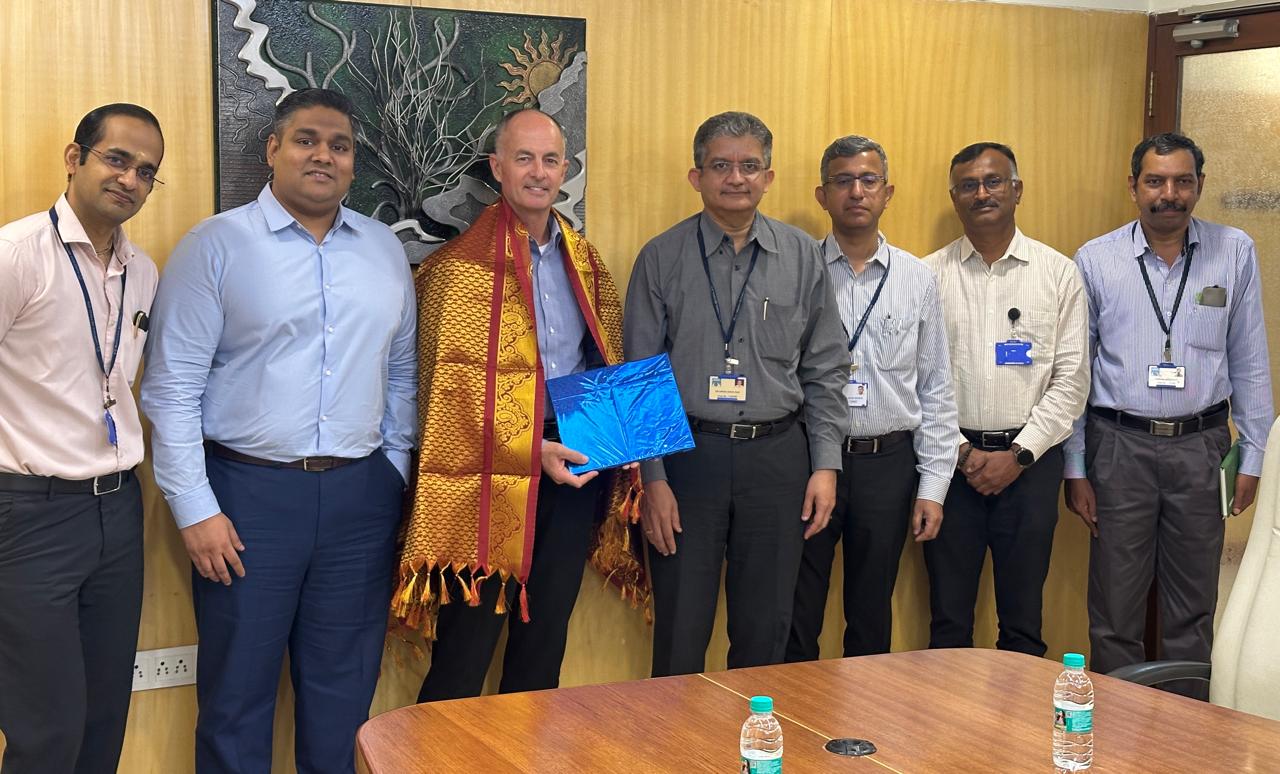
- Guwahati, India. HelpMeSee partnered with HMS Vision Private Limited and Sri Sankaradeva Nethralaya to launch a cataract learning center aimed at building immediate surgical capacity in Northeast India. (8)
- Ibadan, Nigeria. HelpMeSee joined with the Eleta Eye Institute and Christian Blind Mission to open the country’s first simulation-based cataract surgery training center, described as the most comprehensive MSICS simulation-based training program in the world. (9)
Beyond the Operating Room
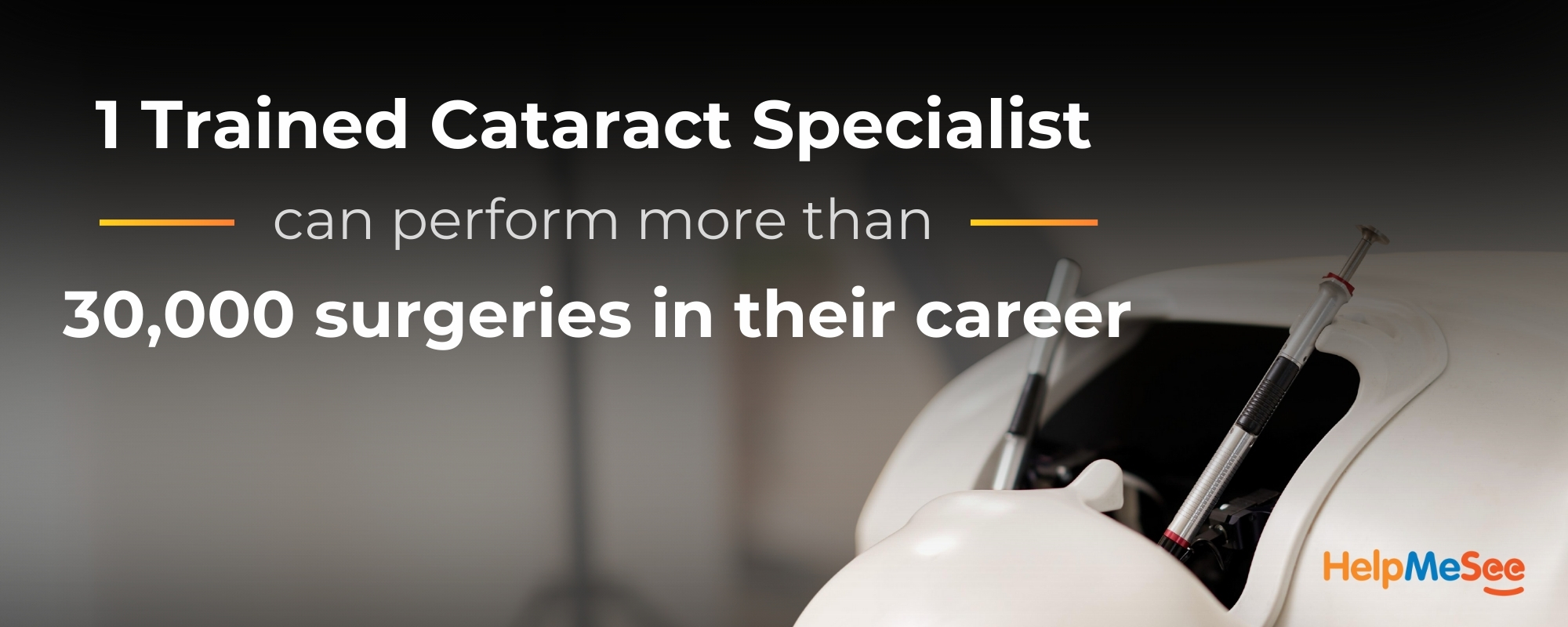
The math behind the work of HelpMeSee is worth considering. A single trained cataract specialist can perform as many as 30,000 surgeries over a career. (10) Hypothetically, training 30,000 trained specialists could translate into roughly 900 million surgeries over their collective careers. Herein lies the strongest argument for innovative, virtual reality–based surgical training as a real lever for change.
It’s also why partnership and shared standards matter as much as surgical technique. A better simulator or a better technology only closes the quality gap if it can be delivered consistently, at scale, in partnership with the institutions and communities that carry the work forward long after training ends.
Conclusion
The future of global ophthalmology depends on pairing a renewed case for techniques like MSICS with the partnerships and shared standards needed to place that innovation into the hands of surgeons everywhere it’s needed. It’s the work HelpMeSee is committed to advancing, one trained surgeon, one partnership, and one standardized curriculum at a time.
Laura Straub is a medical communications strategist and writer. Reach her at [email protected].
REFERENCES
- Vision Loss Expert Group of the Global Burden of Disease Study; GDB 2019 Blindness and Vision Impairment Collaborators. Global estimates on the number of people blind or visually impaired by a cataract: a meta-analysis from 2000 to 2020. Eye (Lond). 2024; 38(11):2156-2172.
- Min L, Wenchang J, Song J, et al. Global prevalence and years lived with disability (YLDs) of cataract in 204 countries and territories: findings from the Global Burden of Disease Study 2021. Eye (Lond). 2025;39:1737-1743.
- Resnikoff S, Landingh VC, Washburn L, et al. Estimated number of ophthalmologists worldwide: will we meet the needs? Br J Ophthalmol. 2020;104(4):588-592.
- Ophthalmology simulation training – cataract surgery simulation. Accessed August 4. 2026. https://helpmesee.org/simulation-based-training/?gad_source=1&gad_campaignid=23837271730&gbraid=0AAAAAouna5sEgP90lpl0COU71bDkhcb5o&gclid=Cj0KCQjw7eXTBhDBARIsAKF-w47J7BZ9ySpw09iBTzjdIPAKzZulI4FHOj0v6siiHpGxKwLUtVW_wU8aAg3IEALw_wcB
- Madhani CH, Trivedi KY, Bhagat PR. Global preferred practice patterns in manual small incision cataract surgery. Gl J Cataract Surg Res Ophthalmol. 2021;1(1):4-9.
- Nair AG, Ahiwalay C, Bacchav AE, Sheth T, Lansingh VC. Assessment of a high-fidelity, virtual reality-based, manual small-incision cataract surgery simulator: A face and content validity study. Indian J Ophthalmol. 2022;70(11):4010-4015.
- Dormegny L, Schaeffer M, Neumann N, et al. Validity assessment for technical skills and stress management of the HelpMeSee manual small incision cataract surgery module. Acta Ophthalmol. 2026;104(5):e503-e515.
- HelpMeSee accelerates MSICS training in India with new Guwahati cataract learning center to build immediate surgical capacity. May 21, 2026. Accessed August 4, 2026. https://helpmesee.org/helpmesee-accelerates-msics-training-in-india-with-new-guwahati-cataract-learning-center-to-build-immediate-surgical-capacity/
- HelpMeSee, Eleta Eye Institute, and Christian Blind Mission Launch Nigeria’s first simulation-based cataract surgery training center. February 24, 2026. Accessed April 30, 2026. https://www.prnewswire.com/news-releases/helpmesee-eleta-eye-institute-and-christian-blind-mission-launch-nigerias-first-simulation-based-cataract-surgery-training-center-to-combat-public-health-crisis-302695105.html
- From darkness to light: training cataract specialists to end preventable blindness. September 18, 2025. Accessed August 4, 2026. https://helpmesee.org/from-darkness-to-light-training-cataract-specialists-to-end-preventable-blindness/


 French
  English
  Spanish