

By Laura Straub
Imagine an elderly woman in Nigeria who can’t recognize the faces of her grandchildren. A farmer in Ghana who can no longer navigate his own fields. A young student in Guatemala who is told her world will fade to a blur. These people share the same enemy: an untreated cataract.
The cruel irony is that cataract blindness is curable, but across the regions where it strikes the hardest there are not enough trained cataract specialists to reach everyone waiting. In Madagascar, a nation of approximately 29 million people, only 25 ophthalmologists are trained to perform cataract surgery. Most of them practice in the capital city or other large towns, leaving the rural majority vastly underserved.1 Nigeria, on the other hand, has more than 540 ophthalmologists and 17 training institutions. Yet the cataract surgical rate in the country sits at just 317 procedures per million people per year.2
So how can these issues be solved? It is not a question of medicine as much as a question of who has been trained, and where.
Now imagine two cataract surgeons. One is steady handed, rigorously trained, and confident. The other is equally talented and driven but practices in a region where training resources are scarce; mentorship is inconsistent, and every early case carries the nervousness and anxiety which is felt in the first cases. The confident surgeon may have learned their craft first on a high-fidelity virtual reality simulator before graduating to a live operating room. HelpMeSee is working to bring this option to more cataract surgeons, regardless of their geographical location.
It Takes a Village
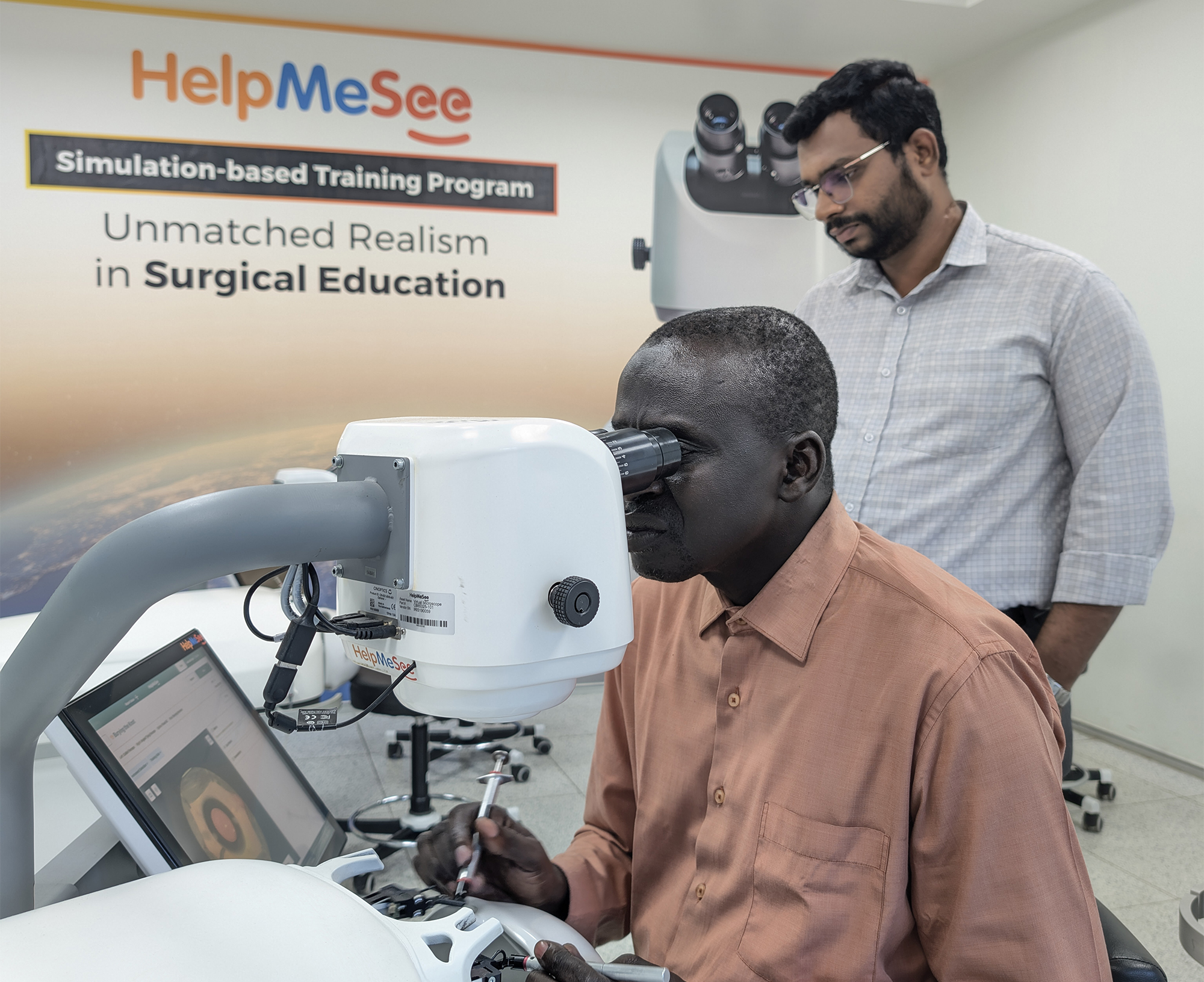
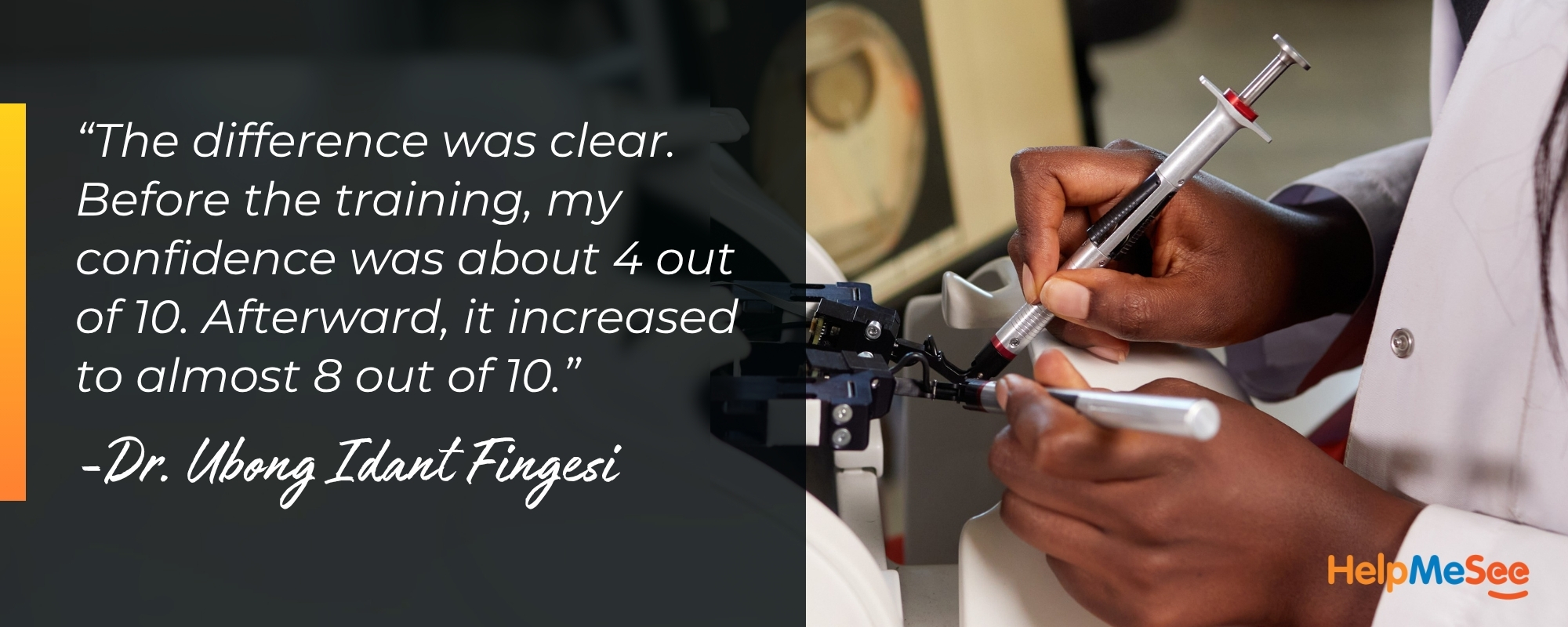
No single institution can close the cataract blindness gap alone. A shared commitment across borders, disciplines, and sectors, however, is an effective strategy for training more cataract specialists closer to where they’re needed most. That is exactly what HelpMeSee has built with its instructor-led, simulation-based cataract surgery training program.
US universities have had similar experiences with HelpMeSee. “Their model of an instructor-led course of concentrated, high-fidelity simulation training represents a paradigm shift in ophthalmic education that will make our residents stronger surgeons,” said Royce W.S. Chen, MD, Associate Professor of Ophthalmology, Columbia University Medical Center.4
Columbia University Medical Center has partnered with HelpMeSee to elevate its residency training program. Additionally, HelpMeSee collaborates with eye hospitals, governmental bodies seeking to address public health crises, global nongovernmental organizations committed to equitable care, and technology companies investing in human potential (for a sampling of partners, see the sidebar).
A Growing Constellation of Institutions
Together, HelpMeSee and its partners form something greater than the sum of their parts: a growing constellation of institutions united by the belief that sight is a human right, not a privilege of geography. Providing simulation-based training programs within institutions in low-resource settings decreases the need for trainees to travel abroad. The following paragraphs portray a snapshot of efforts being made in several underserved areas across the world.
Africa. In sub-Saharan Africa, the need for cataract care is acute. Earlier this year, HelpMeSee, the Eleta Eye Institute, and Christian Blind Mission (CBM) collectively launched Nigeria’s first simulation-based cataract surgery training center in Ibadan.5 In Ghana, the Lions International Eye Centre at Korle Bu Teaching Hospital is both a training site for Ghanaian residents and a center of excellence for all of West Africa.6 Other partners within Africa include Kilimanjaro Christian Medical Centre in Tanzania and The Mazava Program in Madagascar.
“To eliminate cataract blindness, we must invest in training that is accessible, standardized, high-quality, and scalable, and the HelpMeSee Simulation-based Training Program ensures that no cataract specialist is left behind,” Omoi Samuel, Country Director for Nigeria, CBM, said.
Latin America. Cataract trainees from Honduras, Peru, Costa Rica, Nicaragua, Bolivia, Argentina, and Colombia have completed fellowships that included Simulation Based Training at the Instituto Mexicano de Oftalmología (IMO) in Querétaro, Mexico. Not only have they returned to their hometowns to provide sight-saving surgery,7 but they’ve taught others in their communities.
In May 2025, HelpMeSee expanded its Latin American footprint with additional institutional partnerships with Visualiza, which performs more than 30% of the cataract surgeries in Guatamala,8 and Clínica Oftalmológica del Caribe in Colombia, a clinic recognized by Forbes for innovation that reaches more than 300,000 patients annually.9
“These new partnerships expand the geographic reach of simulation-based training and reinforce our shared commitment to providing effective and equitable surgical education to future cataract surgeons,” Dr. Van Lansingh, Director of Research and Business Development for Latin America, HelpMeSee, said.
United States and Europe. A little more than a year ago, HelpMeSee established simulation-based training partnerships with Columbia University Irving Medical Center among others,4 these US academic partnerships validate the model in the world’s most scrutinized medical education systems.
Conclusion
Each new center HelpMeSee partners with adds to the infrastructure designed to help train the next generation of cataract specialists. Not only do trainees take their newfound skills back into their communities, but they become the instructors, mentors, and advocates who train fellow surgeons. They also become living proof that world-class surgical training belongs everywhere.
Laura Straub is a medical communications strategist and writer. Reach her at [email protected].
- JB Randrianaivo et al., “Blindness and cataract surgical services in Atsinanana region, Madagascar,” Middle East Afr J Ophthalmol, 21, 153 (2014). PMID: 24791107.
- Onyia O, Aghaji AE, Ubaka C, Achigbu EO, Ejiakor IL, Mbatuegwu AI, et al. Assessing the cataract surgical rate and gender equity in cataract services in south-east Nigeria. BMJ Open Ophthalmology. 2024;9:e001326. https://doi.org/10.1136/bmjophth-2023-001326
- PRNewswire. HelpMeSee expands simulation-based cataract surgery training with new partnerships at USC and UIC. January 16, 2025. Accesed April 30, 2026. https://www.prnewswire.com/news-releases/helpmesee-expands-simulation-based-cataract-surgery-training-with-new-partnerships-at-usc-and-uic-302352390.html
- HelpMeSee. HelpMeSee announces global launch of next-generation simulation-based eye surgery training for phacoemulsification. April 28, 2023. Accessed April 30, 2026. https://helpmesee.org/helpmesee-announces-global-launch-of-next-generation-simulation-based-eye-surgery-training-for-phacoemulsification/
- PRNewswire. HelpMeSee, Eleta Eye Institute, and Christian Blind Mission launch Nigeria’s first simulation-based cataract surgery training center. February 24, 2026. Accessed May 4, 2026. https://www.prnewswire.com/news-releases/helpmesee-eleta-eye-institute-and-christian-blind-mission-launch-nigerias-first-simulation-based-cataract-surgery-training-center-to-combat-public-health-crisis-302695105.html
- PRNewswire. HelpMeSee launches new simulation-based training center in Ghana to advance cataract surgery education in West Africa. February 11, 2026. Accessed May 4, 2026. https://www.prnewswire.com/news-releases/helpmesee-launches-new-simulation-based-training-center-in-ghana-to-advance-cataract-surgery-education-in-west-africa-302684506.html
- The Ophthalmologist. HelpMeSee: transforming lives through training: part III. February 2023. Accessed May 4, 2026. https://theophthalmologist.com/issues/2023/articles/feb/helpmesee-transforming-lives-through-training-part-iii
- PRNewswire. HelpMeSee Expands Latin American training network with new partnerships in Guatemala and Colombia. May 29, 2025. Accessed May 4, 2026. https://www.prnewswire.com/news-releases/helpmesee-expands-latin-american-training-network-with-new-partnerships-in-guatemala-and-colombia/


 French
  English
  Spanish