

Key Takeaways
- Nigeria achieves a major milestone with its first in-country HelpMeSee-trained resident ophthalmologist
- Simulation-based cataract surgery training helps bridge the gap between practice and live surgical performance
- Limited surgical exposure and inconsistent case volume continue to hinder ophthalmology training in Africa
- Addressing training gaps is critical as millions in Africa remain untreated for cataract-related blindness
For many ophthalmology residents, the transition from training models to live cataract surgery is one of the most defining and daunting moments in their careers.
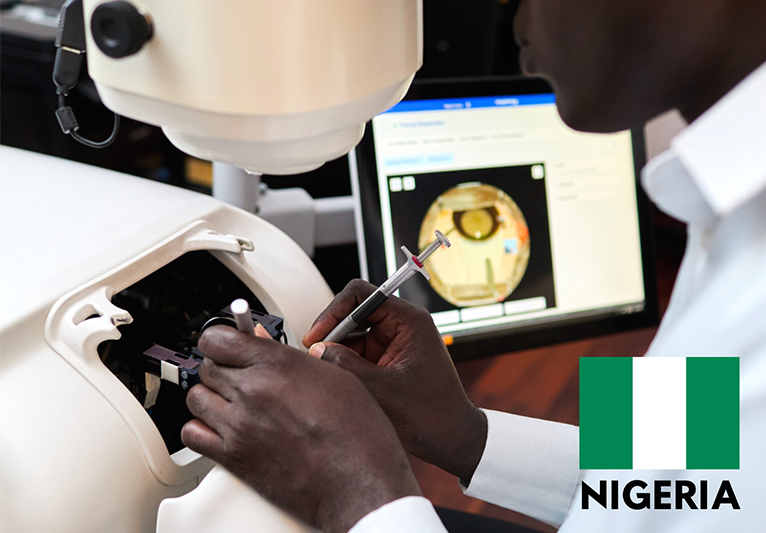
For Dr. Ubong Idant Fingesi, a second-year resident at Babcock University Teaching Hospital in Ilishan, that transition once felt uncertain until he experienced simulation-based training with HelpMeSee at the Simulation Training Centre in Eleta Eye Institute Ibadan, Nigeria, which was established in collaboration with Christian Blind Mission.

The Challenge of Traditional Training
Like many surgical trainees around the world, Dr. Ubong Idant Fingesi began learning cataract surgery using animal eyes.
“After practicing with goat eyes, you’re expected to transition to human eyes,” he explains. “But there’s a big difference. Even after training, I still didn’t feel confident.”
This gap between early-stage practice and real surgical performance is widely recognized in ophthalmology education. Traditional apprenticeship models often limit opportunities for repeated, risk-free practice, leaving cataract surgeons and cataract specialists to build skill and confidence while operating on patients.
In many settings, this challenge is compounded by limited surgical exposure and inconsistent case volumes. Variability in training opportunities remains a major barrier to achieving consistent surgical competency among cataract trainees. [1]
The result is a familiar pattern: hesitation, anxiety, and delayed readiness. [2]
A Growing Surgical Gap in Africa
This training challenge exists within a much larger structural issue which is a shortage of proficiently trained ophthalmologists across Africa.
According to the World Health Organization’s 2026 update, three in four people in Africa who need cataract surgery remain untreated, representing the largest unmet need globally. [3] At the same time, progress toward global eye health targets is falling short, with cataract surgical coverage projected to increase by only about 8.4 percent from the baseline this decade, which is far below the 30-percent target set for 2030. [3]
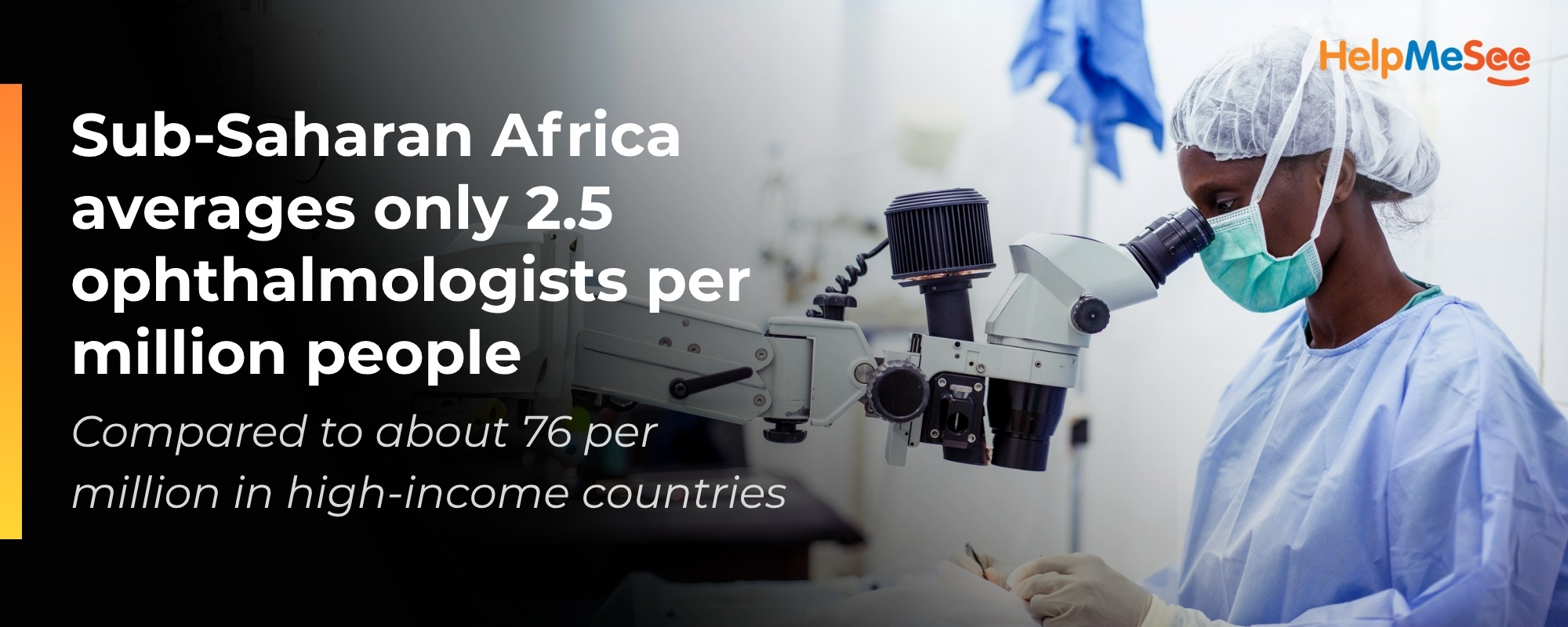
In many parts of sub-Saharan Africa, there are only 2–3 ophthalmologists per million people, compared to far higher densities in high-income countries. [4] In Nigeria specifically, surgical capacity remains far below need, with cataract surgery rates that are significantly below the level required to eliminate avoidable blindness. [4]
The implications are profound:
- Millions remain blind from a treatable condition
- The cataract surgery backlog continues to grow
In this context, scaling quality training for cataract surgeons is an educational priority and a public health necessity.
A Turning Point with Simulation
Everything changed during Dr. Fingesi’s two-week training with the HelpMeSee Simulation-based Training Program.
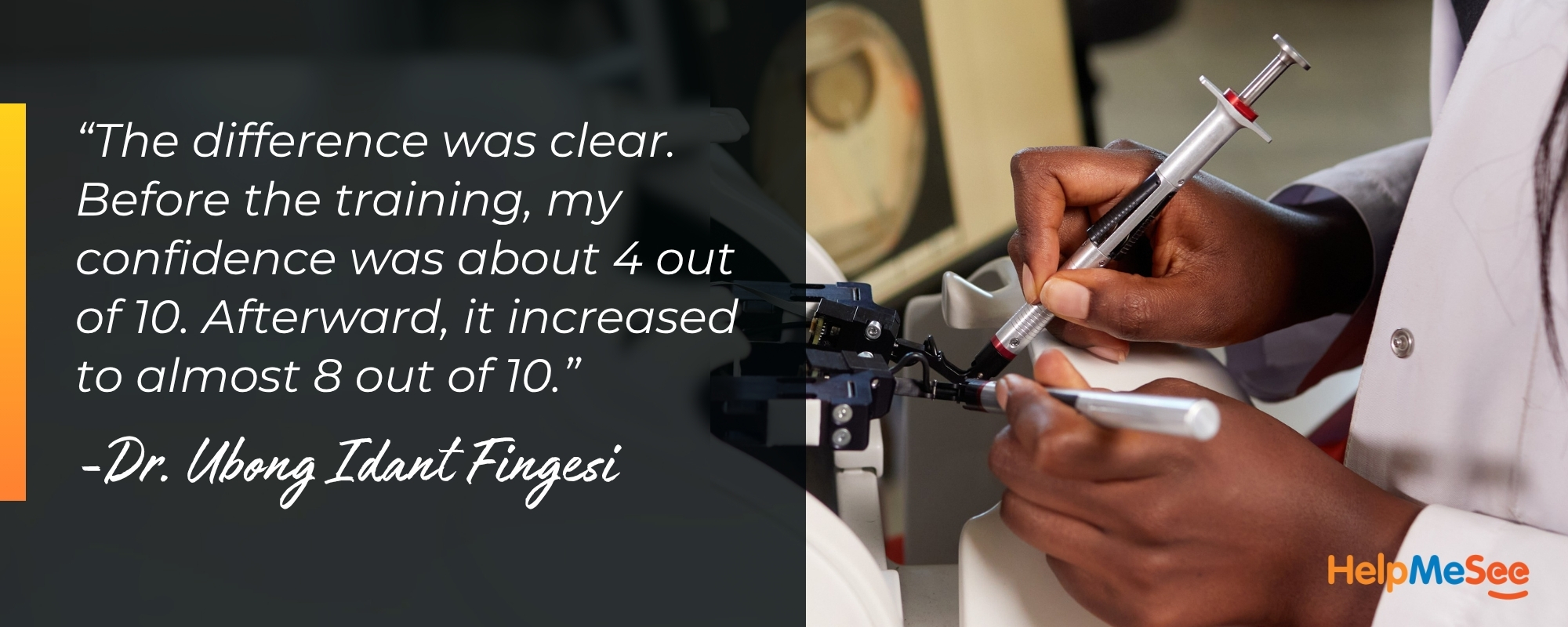
“The difference was clear,” he says. “Before the training, my confidence was about 4 out of 10. Afterward, it increased to almost 8 out of 10.”
Unlike traditional models, simulation-based training allows for deliberate, structured practice. Trainees can repeat critical surgical steps, receive immediate objective performance analysis and instructor feedback while progress is based on demonstrated skill, not just time spent.
The HelpMeSee approach is increasingly supported by evidence. A 2024 study in Ophthalmology Science found that simulation-based cataract surgery training improves surgical performance and helps reduce complications among early-stage surgeons. [5]
For Dr. Fingesi, the impact was immediate in technical surgical skills and in his confidence.
There was one defining moment that marked the shift from uncertainty to readiness.
“I remember when I was finally able to enter the eye and deliver the cataract nucleus,” he says. “That was when I knew—I am ready,” said Dr. Fingesi.
This moment represents more than a technical milestone and reflects a core principle of competency-based medical education.
Rather than progressing based on time or exposure alone, competency-based medical education focuses on demonstrated proficiency. Ophthalmologists and cataract surgeons advance when they can consistently perform key steps safely and effectively, not simply because they have completed a set number of cases or hours.
Simulation plays a critical role in enabling this model. It allows cataract specialists, residents and surgeons to:
- Practice repeatedly until mastery is achieved
- Receive objective, skills-based feedback
- Build confidence before operating on patients
In this framework, Dr. Fingesi’s breakthrough was the result of structured, competency-driven training.
A 2025 multi-center study in the Journal of Cataract & Refractive Surgery found that simulation-trained residents reached competency benchmarks faster and with greater consistency than those trained through traditional pathways alone. [6]
For Dr. Fingesi, this was the moment training was translated into surgical readiness where skill, confidence, and proficiency aligned.
A Milestone for Nigeria
Dr. Fingesi is now recognized as the first in country trained Nigerian ophthalmology resident using the HelpMeSee Simulation-based Training Program in a Simulation Training Centre in Nigeria which is a milestone that signals a broader shift in surgical education in Nigeria.
“This opportunity means a lot,” he shares. “It shows what is possible for young doctors. And I know I won’t be the last.”
His experience reflects what is possible when training innovation meets local needs. In regions where surgical capacity is limited, improving training efficiency and readiness can have an outsized impact.
A Message to Future Trainees
For those considering ophthalmology but uncertain about the complexity of eye surgery, Dr. Fingesi offers a clear message:
“Don’t be afraid. With the right training, these procedures become achievable.”
Simulation is helping redefine how surgeons are prepared by strengthening traditional training through instructor-led curriculum and simulation-based training. It creates a pathway where confidence is built before responsibility, not after.
“Ophthalmology is a very rewarding field,” he adds. “And now it is easier to learn safely and confidently.”
Expanding What’s Possible
Dr. Fingesi’s journey reflects a broader shift in surgical education toward simulation-based, competency-driven training that can help scale surgical capacity without compromising patient safety. In Africa, where the gap between cataract surgery needs and surgical capacity remains significant, improving how surgeons are trained is critical.
Simulation-based training allows surgeons to gain confidence and proficiency before operating on patients, accelerating readiness and improving outcomes. As more training institutions adopt this approach, the impact could extend far beyond individual surgeons to entire health systems.
Expanding access to high-quality surgical training today is essential to reducing preventable blindness tomorrow. Organizations and training institutions interested in strengthening cataract surgical training are encouraged to explore simulation-based training partnerships and programs. At a time when millions still lack access to sight-restoring surgery, these advances are essential. In Nigeria, that future has already begun.
- “Simulation Training in Ophthalmology: Improving Cataract Surgery Education.” The Ophthalmologist, 2023, www.theophthalmologist.com.
- Effectiveness of Simulator-Based Training for Cataract Surgery in Postgraduate Ophthalmology Residents. 2026.
- World Health Organization (2026). Global update on cataract surgical coverage and access gaps.
- International Agency for the Prevention of Blindness. Vision Atlas: Global Data on Vision Loss and Eye Health Workforce. International Agency for the Prevention of Blindness, https://visionatlas.iapb.org/. Accessed 25 Mar. 2026.


 French
  English
  Spanish