

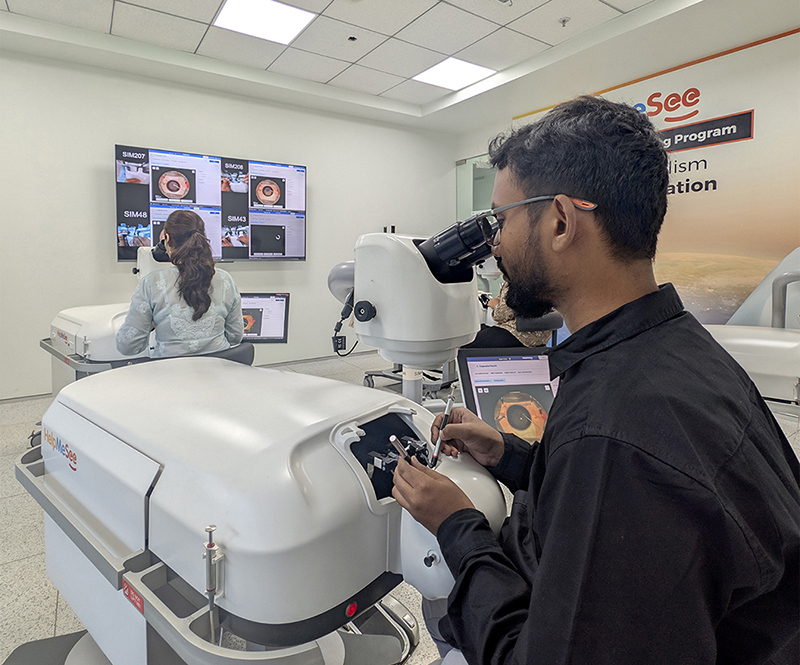
Today, about 45% of all global blindness is due to cataract. (1) After more than a decade of training surgeons across India, Madagascar, China, Mexico, and beyond, HelpMeSee has learned some important things about what it takes to reduce the cataract blindness backlog. First and foremost, it requires more than technology, funding, and good intentions. This mission has driven HelpMeSee to rethink surgical education from the ground up, building toward a world where distance is no longer the deciding factor between a patient and restored sight.

The Case for a Different Model
Traditional surgical training is volume-dependent. Residents learn by progressing from observation to supervised live surgery, accumulating experience over months and years. This model, however, breaks down at global scale. Ophthalmology trainees in India have reported a lack of opportunity to perform independent cataract surgery during residency. In a survey of 740 ophthalmology residents across India, only 40.1% performed cataract surgery independently. Of those who had not, 62.5% were already in their third or final year of residency. (2) In other parts of the world like Africa, some residents graduate without performing a single independent cataract surgery case. (3)
Le HelpMeSee Eye Surgery Simulator, a high-fidelity virtual reality platform for Chirurgie de la cataracte par petite incision manuelle (MSICS), incorporates realistic optical rendering and haptic feedback into training. In a face and content validity study of 35 experienced MSICS surgeons, 74.3% felt the simulator’s visual representation was realistic to a surgical environment. (4)
The Instructor is not Optional
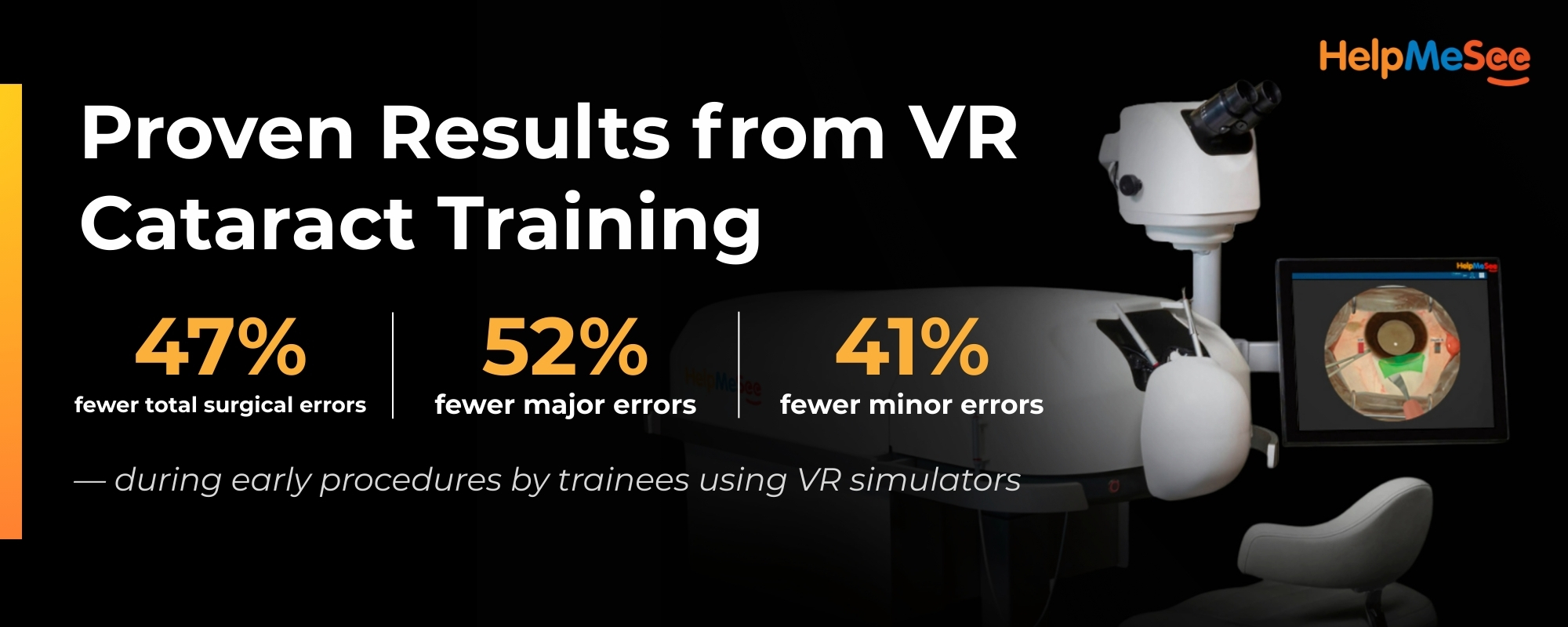
Participants in the HelpMeSee program perform between 300 and 500 simulated attempts in a focused training period. Although this model generates substantial and deliberate practice not achievable through live surgery alone, high volume alone is not enough to produce a surgeon who is truly ready to operate. A multicenter, investigator-masked, randomized, controlled trial showed novice surgeons trained on simulation software made significantly fewer errors than conventionally trained peers in their first 20 live MSICS procedures, (5) and the curriculum that produced those results was instructor-led, not self-directed.
Instructors who effectively lead simulation training programs demonstrate technique, observe trainees in real time, interpret simulator performance data, conduct structured debriefing sessions, and make final competency assessments. Research confirmed that expert verbal feedback outperforms self-directed review for acquiring new surgical skills. (6) HelpMeSee instructors therefore undergo standardized training so that a trainee in Madagascar receives equivalent instructional support to one in India or Mexico, creating a program integrity and consistency that does not bend to geography.
Competency Over Credentials
One consequential shift in the HelpMeSee simulation training model is a shift away from time-based toward competency-based progression. Whereas a time-based standard may produce inconsistent outcomes, a competency-based standard ensures every trainee meets a demonstrated performance threshold before progressing their learning.
HelpMeSee researchers developed and validated a 30-metric MSICS assessment tool drawn from the simulator’s built-in performance data. In validation testing, only one of 15 surgeons with no MSICS experience achieved a passing score (mean, 15.5), while seven of 10 experienced MSICS surgeons passed (mean, 22.7), confirming the equipment’s ability to reliably discriminate between skill levels. (7) Trainees do not advance to live surgery until they demonstrate readiness on this standard. By replacing ceremonial progression with genuine preparation, both trainees and patients are protected.
Adapting Without Compromising
To deploy training across varying infrastructures, regulatory environments, and professional cultures, HelpMeSee partners with medical institutions and eye hospitals as well as governmental bodies and nongovernmental organizations to subsidize access to training. Tactics such as offline pre-course materials for low-connectivity settings; intensive residential course formats for trainees traveling significant distances; and expansive partnerships with local hospitals and eye institutes create training support structures. Countries including India, Madagascar, Mexico, Nigeria, Ghana, Tanzania, Guatemala, and Colombia have successfully integrated the model into existing medical education frameworks.(8-10)
Impact measurement has also shaped the program’s evolution. Surgeons who trained under HelpMeSee not only return to their communities to perform surgery at meaningful volume but deliver outcomes that meet or exceed quality standards. The chain of accountability from simulator to operating room to patient outcomes is what ongoing research is designed to trace. It has also informed the architecture of the next-generation Comprehensive MSICS Training System, which extends beyond simulation to cover the entire cataract systems from preoperative diagnostics through postoperative care. (11) Such additional competencies are necessary for a durable reduction in cataract blindness.
Principles That Travel
Scaling surgical training across diverse healthcare systems does not happen only by deploying technology. Real change comes by building a system that pairs the right technology with structured mentorship, objective competency standards, and local context. These principles are not unique to ophthalmology or MSICS, but they are what large-scale, high-stakes surgical education demands. With cataracts responsible for nearly half of all blindness worldwide, (1) the people waiting for restored sight aren’t waiting for a new surgical technique to reach them but rather a trained surgeon who can.
REFERENCES
- Burton M, Ramke J, Marques A et al. The Lancet Global HealthCommission on Global Eye Health: vision beyond 2020. The Lancet Global Health, 2021; 9, e489-e551
- Nair AG, Mishra D, Prabu A. Cataract surgical training among residents in India: results from a survey. In J Ophthalmol. 2023;71(3):743-749.
- Dean W, Gichuhi S, Buchan J, et al. Survey of ophthalmologists-in-training in Eastern, Central and Southern Africa: a regional focus on ophthalmic surgical education. Wellcome Open Res. 2019;4:187.
- Nair AG, Ahuja A, Lansingh VC, et al. Assessment of a high-fidelity, virtual reality-based, manual small-incision cataract surgery simulator: a face and content validity study. In J Ophthalmol. 2022;70(11):3865-3870.
- Lansingh VC, Nano ME, Nano HC, et al. Effectiveness of simulation-based training for manual small incision cataract surgery among novice surgeons: a randomized controlled trial. Sci Rep. 2021;11(1):11081.
- Lansingh VC, Nair AG. More than simulation: the HelpMeSee approach to cataract surgical training. Community Eye Health. 2023;36(119):Epub 2023 Dec 1.
- Kolodzey L, Lansingh VC, Nair AG, et al. A validated test has been developed for assessment of manual small incision cataract surgery skills using virtual reality simulation. Sci Rep. 2023;13(1):10655.
- HelpMeSee, Eleta Eye Institute, and Christian Blind Mission Launch Nigeria’s first simulation-based cataract surgery training center. February 24, 2026. Accessed May 20, 2026. https://www.prnewswire.com/news-releases/helpmesee-eleta-eye-institute-and-christian-blind-mission-launch-nigerias-first-simulation-based-cataract-surgery-training-center-to-combat-public-health-crisis-302695105.html
- HelpMeSee launches new simulation-based training center in Ghana to advance cataract surgery education in West Africa. February 11, 2026. Accessed May 20, 2026. https://www.prnewswire.com/news-releases/helpmesee-launches-new-simulation-based-training-center-in-ghana-to-advance-cataract-surgery-education-in-west-africa-302684506.html
- HelpMeSee Expands Latin American training network with new partnerships in Guatemala and Colombia. May 29, 2025. Accessed May 20, 2026. https://www.prnewswire.com/news-releases/helpmesee-expands-latin-american-training-network-with-new-partnerships-in-guatemala-and-colombia
- HelpMeSee Unveils Next-Generation MSICS Training System at SAFO. February 2026. Accessed May 20, 2026. https://helpmesee.org/helpmesee-unveils-next-generation-msics-training-system-at-safo-to-scale-global-blindness-solutions/


 French
  English
  Spanish