

Two experts share what mastery really looks like in the operating room.

Manual small incision cataract surgery (MSICS) is often taught as a sequence of precise steps that include incision construction, capsulorhexis, nucleus extraction, cortical cleanup, and intraocular lens placement. Yet if you asked 10 experienced cataract surgeons what mastery looks like, you would likely hear 10 different answers. The truth is that MSICS mastery looks different in the operating room than it does in training videos and didactic curricula. It’s less about executing steps perfectly and more about judgement, control, and adaptability in real time.
Below, two HelpMeSee Instructors with decades of combined clinical and teaching experience share their insights on what MSICS mastery truly means, the lessons every trainee must learn, and the subtle skills that help transform a technique into a lifelong surgical craft.
Minimize the Learning Curve
MSICS can have a steep learning curve, particularly because the technique demands a tactile awareness, spatial judgment, and respect for the ocular tissue that cannot be captured in textbooks or lectures. As a result, early surgical cases often feel unforgiving. A small deviation in tunnel construction, capsulorhexis size, or nucleus manipulation may quickly compound into larger challenges.
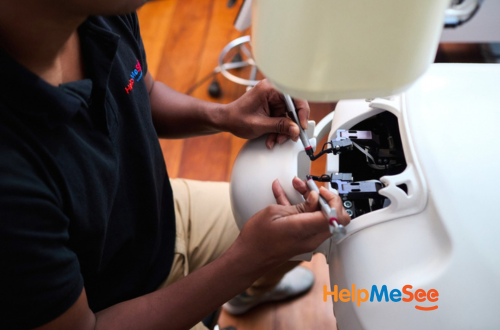
One way to prepare for the challenge a surgeon can face during MSICS is with a structured training program that provides real-time feedback. A simulation-based learning platform such as the HelpMeSee Surgical Simulator allows trainees to practice critical steps repeatedly in a safe, controlled environment. Here, mistakes become learning opportunities rather than patient risks. Combined with expert mentorship and guided reflection, surgeons build confidence, refine technique, and develop sound intraoperative judgment even before performing their first MSICS case.
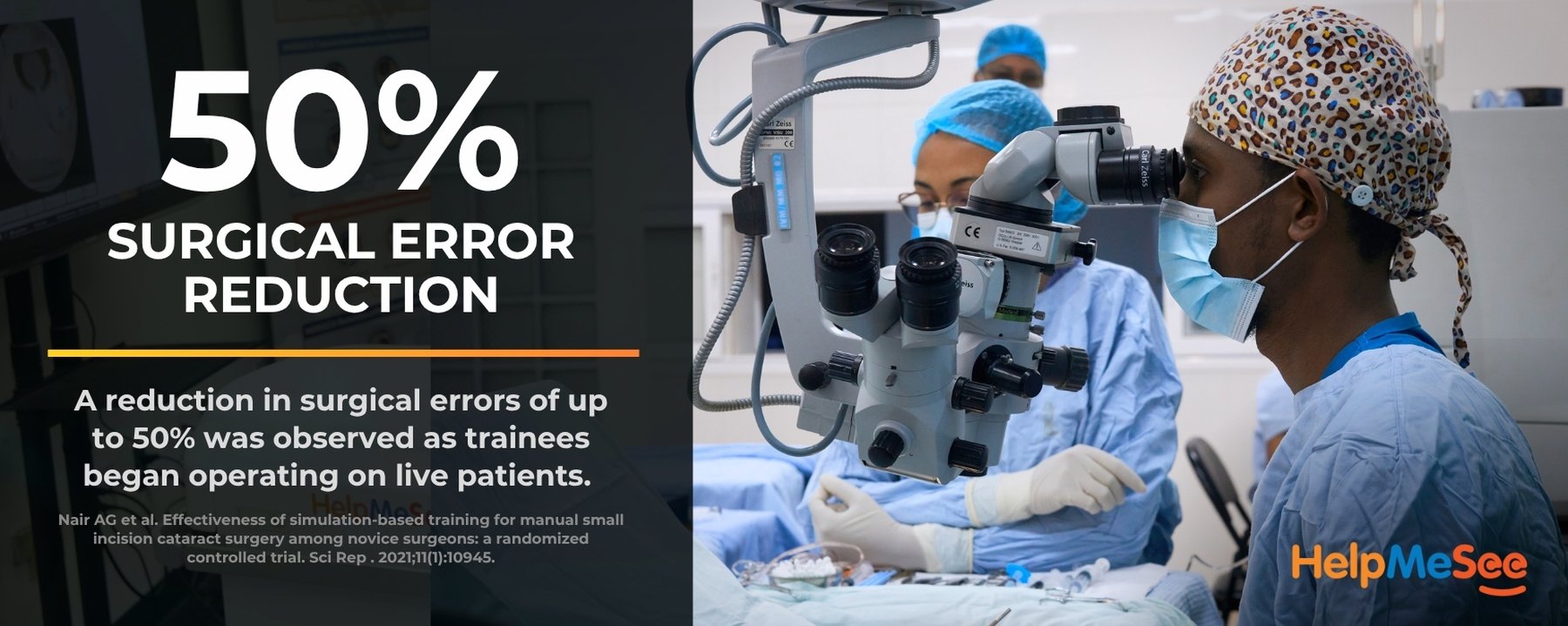
This approach shortens the learning curve, strengthens foundational skills, and prepares surgeons to deliver consistent, high-quality outcomes in real-world settings. A study recently showed performing repeated attempts of MSICS steps in a virtual reality environment not only improved surgical technique but also helped trainees decrease complications.1 Other studies have indicated simulation-based training reduced surgical error volume in the first 20 live procedures trainees performed.2
HelpMeSee instructors witness the realities of overcoming learning curves every day. Their insights support that MSICS proficiency is not just memorizing steps. “MSICS mastery in the OR means the surgery looks calm, controlled, and repeatable, regardless of case difficulty,” Dr. Kimaya Chavan, HelpMeSee Mumbai Lead Instructor, said. “Most importantly, the surgeon anticipates problems early and corrects them quietly without the team feeling any panic.”
Feeling anxious is a common emotion for young cataract surgeons demonstrating their skills in the operating room. “The first cases are always the hardest because you’re still learning to truly master the technique,” Teresa Diaz, lead instructor at Instituto Mexicano de Oftalmología (IMO), said. “Things won’t feel smooth at the beginning, and that’s completely normal. With repetition, confidence grows, movements become more precise, and everything starts to flow better.”
Overcoming Common Mistakes
Heeding advice from instructors is key to overcoming common mistakes during MSICS. They urge young surgeons to think of early struggles not as signs of failure but rather signs of growth. “Each challenging case ultimately makes you a safer and more skilled surgeon,” Dr. Diaz said.
One common early mistake with MSICS, according to Dr. Chavan, is rushing. “Trainees often try to use force instead of finesse,” she said. “This happens because of anxiety and the misconception that good surgeons are fast. But MSICS rewards control, not speed.”
Unlearning habits from other cataract techniques can also be challenging. Dr. Diaz noted how many trainees initially create a phaco-sized capsulorhexis out of habit. “In MSICS, the capsulorhexis needs to be larger to allow easier nucleus prolapse and delivery,” she explained. “Remembering this helps avoid unnecessary difficulty and prevents us from complicating the surgery ourselves.”
MSICS demands tissue respect, anticipation, and thoughtful sequencing over mechanical repetition, Dr. Chavan said. “Difficult cases are part of surgical growth. Confidence returns through understanding, repetition, and improved judgement, not reassurance alone,” she shared.
As trainees progress their surgical technique, they begin to realize that MSICS is not simply a technical procedure but also a cognitive one. Each step requires continuous interpretation of visual and tactile cues. Dr. Chavan describes the importance of noting subtle signals that help guide decision-making in the OR. “A shallow or unstable anterior chamber, increasing corneal edema, abnormal iris behavior, or excessive lens movement are visual cues to slow down,” she said. “Tactilely, increased resistance or loss of smooth instrument glide are warning signs. When these appear, I pause, stabilize the eye, and adjust the plan rather than push ahead.”
Honing one’s ability to “read” the eye distinguishes competent surgeons from truly skilled ones. Mastery emerges when surgeons learn to anticipate complications rather than react to them, shifting to modify their approach without hesitation or ego. Individuals who have performed simulation-based training are better prepared to anticipate complications earlier compared to those who haven’t.1
High-Value Surgical Pearls
In MSICS, small adjustments often yield immense results. Both Drs. Chavan and Diaz emphasized fundamentals rather than advanced tricks as the foundation for success. For Dr. Diaz, the most critical principle is tunnel construction. “If the scleral groove and tunnel are poorly made, the rest of the surgery becomes much more difficult,” she said. “When they are well constructed, they make all the subsequent steps smoother and safer. Mastering this part lays the foundation for a successful MSICS.”
Dr. Chavan highlighted ergonomics and preparation as hidden drivers of performance. “Proper posture, correct microscope settings, and delicate instrument handling significantly improve precision and reduce errors,” she noted. “Struggling in the initial cases is normal, but outcomes improve with consistency, reflection, and experience.”
Both instructors agree on one central truth: Speed should never be the primary goal. “Patient safety comes first,” Dr. Diaz said. “Being fast doesn’t make you a better surgeon. Taking the time needed to do each step correctly leads to better results, and with experience, speed naturally follows.”
Dr. Chavan added, “Gentle instrument handling, delicate movements, and minimal tissue handling are key. Going slow and safe gives better results.”
MSICS is Still Relevant
Despite rapid advances in cataract technology, MSICS is indispensable in modern ophthalmology, especially in regions where access to advanced equipment is limited, and the burden of advanced cataract is high. For HelpMeSee, training surgeons is not about preparing them for ideal surgical conditions but for the realities of diverse clinical environments where adaptability, efficiency, and sound judgment are essential. MSICS therefore plays a critical role in addressing global cataract blindness.
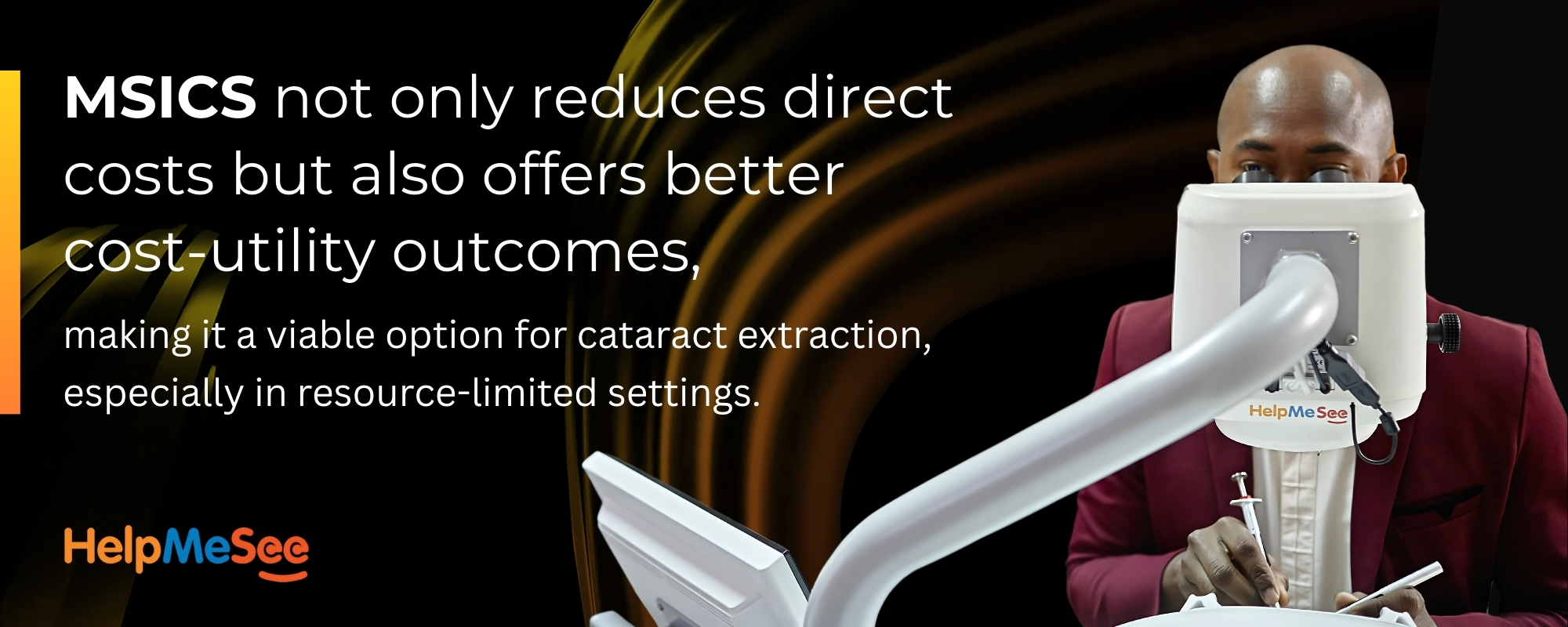
As Dr. Chavan explained, the enduring value of MSICS lies in both its practicality and performance. “MSICS remains important because it is a safe, cost-effective, and a less technology dependent technique that delivers excellent outcomes across all cataract densities, especially in low-resource settings,” she said. “It reliably manages hard cataracts and supports high-volume surgery, making it essential for sustainable and equitable cataract care worldwide.”
Beyond its global impact, MSICS also shapes more capable surgeons. Dr. Diaz noted mastering a manual technique strengthens clinical confidence and versatility across surgical contexts. “Every cataract surgeon should master a manual technique,” she said. “Not all cataracts are suitable for phaco, and MSICS gives you the ability to manage complications safely and confidently. Having this skill expands a surgeon’s versatility and ultimately leads to better patient care.”
What Mastery Really Means
Although a difficult surgery can shake confidence, it is also a powerful teacher. “Revisiting fundamentals through simulation and supervised practice helps rebuild control,” Dr. Chavan said.
Dr. Diaz echoed the perspective. “Every case is different, and even simple surgeries can become complicated,” she said. “What defines a good surgeon is not avoiding complications but knowing how to recognize and manage them. Each challenging case ultimately makes you safer and more skilled.”
Over time, trainees begin to see progress not as perfection but as increasing reliability. They learn to trust their judgment, refine their technique, and embrace the continuous nature of surgical mastery.
And when surgeons master MSICS, they not only master a technique but, more importantly, expand how many lives they can change.
- Sankarananthan R, Prasad RS, Koshy TA, et al. An objective evaluation of simulated surgical outcomes among surgical trainees using manual small-incision cataract surgery virtual reality simulator. Indian J Ophthalmol. 2022;70:4018-25.
- Nair AG, Ahiwalay C, Bacchav AE, et al. Effectiveness of simulation-based training for manual small incision cataract surgery among novice surgeons: a randomized controlled trial. Sci Rep. 2021;11(1):10945.


 French
  English
  Spanish