

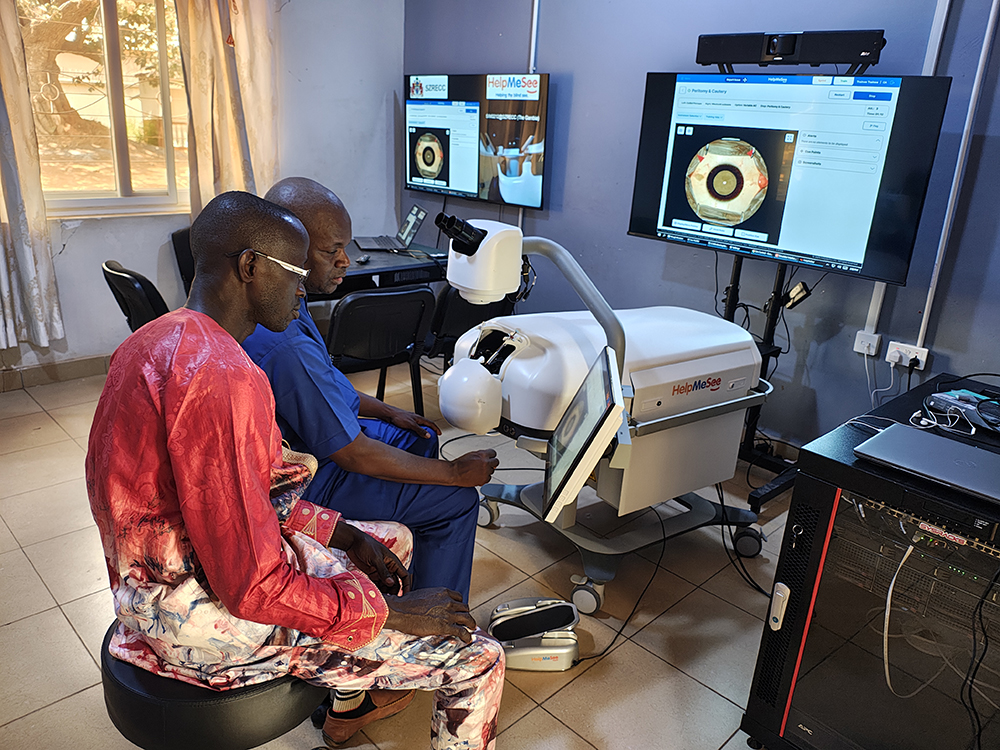
Digital innovation is reshaping global health, and nowhere is this more apparent than in the fight against preventable blindness. In ophthalmology, new technologies like virtual reality (VR), haptics, and simulation-based training are transforming how surgeons are trained, creating scalable solutions to one of the world’s most solvable health challenges.
The Global Need for Scalable, High-Quality Training
Cataract remains the leading cause of blindness worldwide, affecting tens of millions of people – most of whom live in low- and middle-income countries where access to surgical care is limited. While cataract surgery is highly effective and often restores sight with a single procedure, the real barrier is the shortage of trained surgeons able to deliver it at scale. [1]
Global health systems are facing a widening gap: the number of individuals requiring cataract surgery continues to rise due to aging populations, yet the pipeline of adequately trained surgeons is not keeping pace. In fact, workforce projections point to a significant shortfall in ophthalmologists in the coming years, further compounding the backlog of untreated cataract blindness. [2]
To address this crisis, global health leaders are shifting toward scalable, competency-based medical education model approaches that prioritize measurable skill acquisition over time-based training. This is where simulation-based education and advanced technologies play a critical role. By enabling high-volume, proficiency-based training outside the operating room, these tools make it possible to scale cataract surgical education in ways that were previously unattainable and bringing the global community closer to closing the gap between blindness and access to care.
The Role of VR and Haptics in Surgical Training
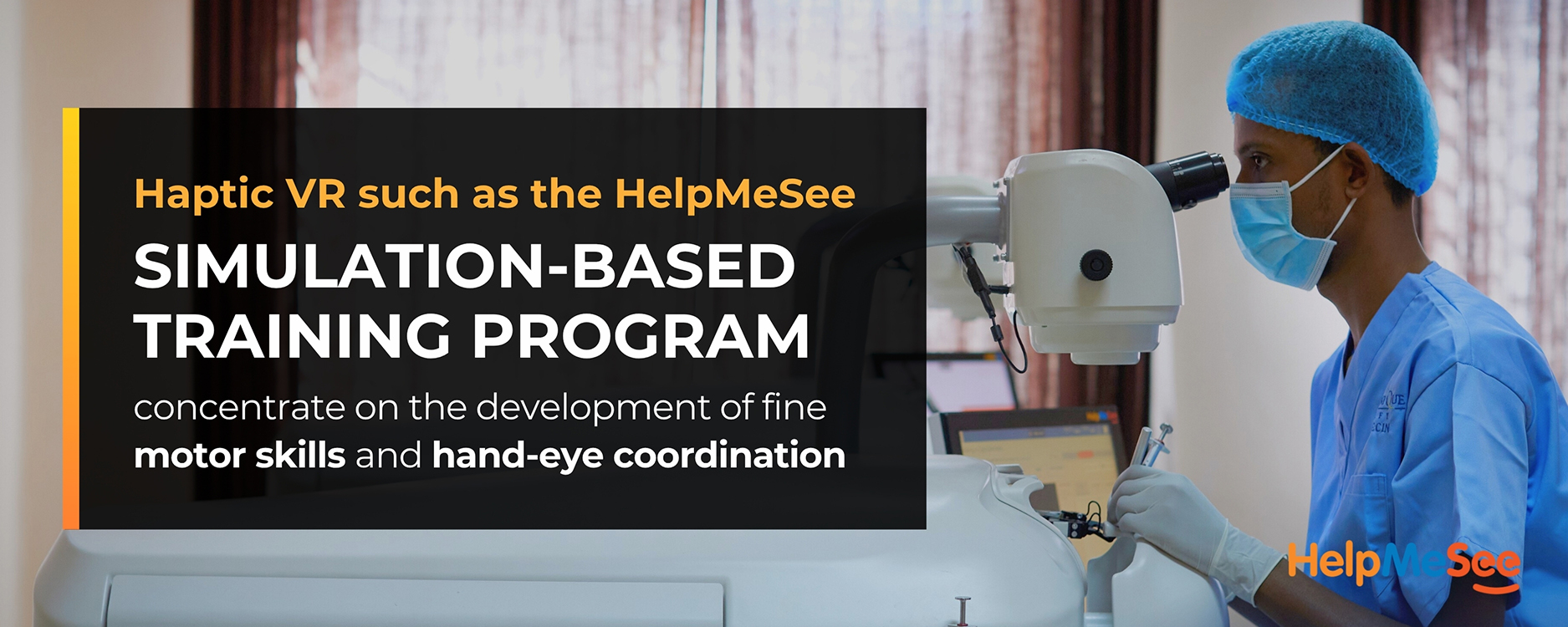
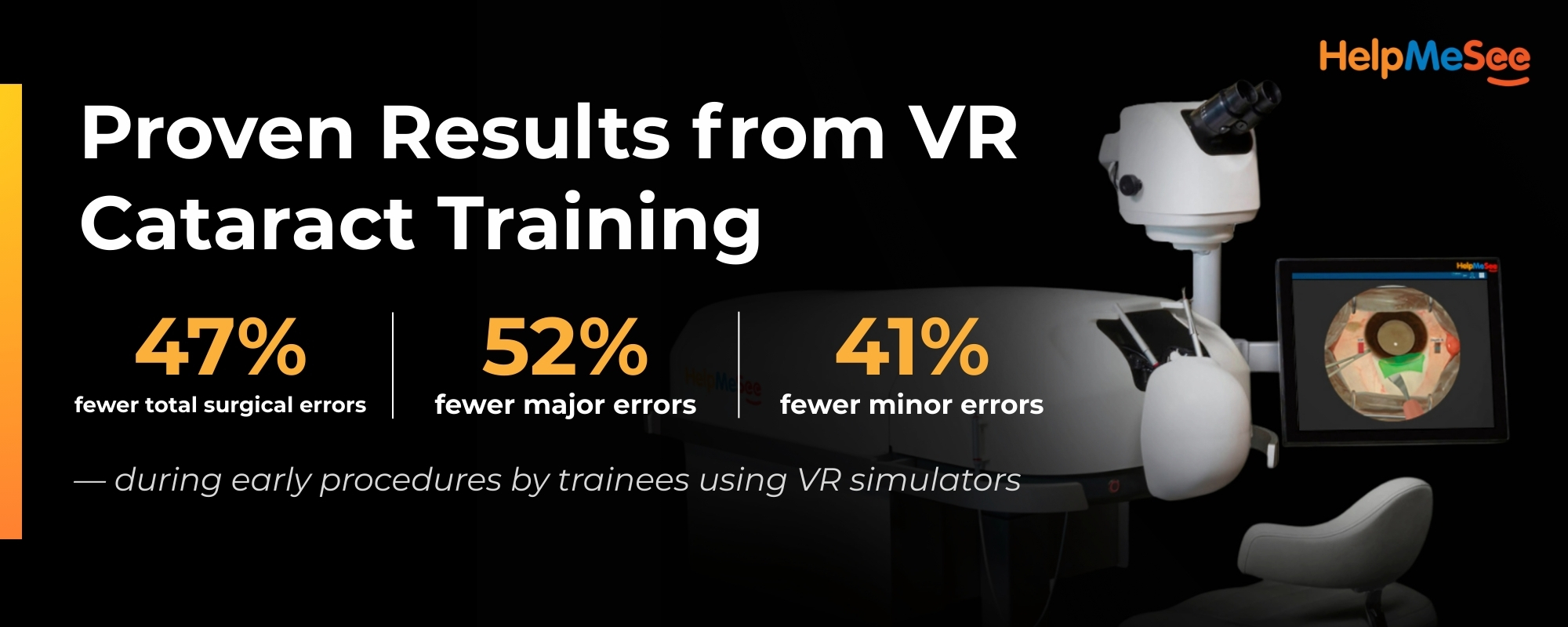
Unlike earlier models that relied primarily on visual cues, modern VR simulators incorporate motor sensory (haptic) feedback, allowing cataract surgeon trainees to feel the resistance and tactile nuances of surgery. Haptic VR systems replicate real surgical environments with high fidelity, accelerate skill acquisition and shorten learning curves, and enhance hand–eye coordination and procedural confidence. Emerging evidence suggests that such immersive environments reduce intraoperative complications, which is an outcome that directly aligns with global health priorities. [4].
One of the greatest advantages of VR-based training is its ability to democratize access to cataract surgical education. Historically, cataract surgery training opportunities have been limited by geography, resources, and access to expert instructors. Today, simulation-based training platforms enable standardized, competency-based training anywhere in the world.
Innovative models including simulation-based instruction and near-peer teaching have demonstrated comparable outcomes to traditional expert-led training, further improving scalability [5].
This aligns with broader global health goals to expand access to quality eye care and reduce avoidable blindness worldwide [1].
A Scalable Model for Humanitarian Impact
Organizations like HelpMeSee are applying these innovations to address the global cataract crisis. By integrating VR, haptics, and competency-based training, they are building a scalable pipeline of skilled surgeons equipped to deliver high-quality care.
This model ensures that training is:
- Standardized across regions
- Focused on measurable proficiency
- Designed to reduce preventable surgical errors
The result is not just more surgeons but better-prepared surgeons, capable of restoring sight safely and effectively at scale.
Investing in the Future of Global Health
The opportunity is clear: investing in surgical training is one of the most scalable ways to reduce global blindness. Cataract blindness affects individuals, families, and entire communities and limits education, economic productivity, and quality of life. Y
By supporting nonprofit innovation in global health, VR surgical training, and competency-based education, donors can create exponential impact:
- Train one surgeon → restore sight to thousands
- Scale training programs → expand access across regions
- Invest in education → build a sustainable global workforce
The return on this investment is profound: restored vision, renewed independence, and transformed lives. Technology has provided the answer. Now, it is up to the global community to scale it.
- McCormick I, Ouchtar Y, Macleod D, et al; the eCSC Study Group. Effective cataract surgical coverage in adults aged 50 years and older: empirical estimates from population-based surveys in 68 countries and modelled estimates for 2000–30. Lancet Glob Health. 2026;14:e367-77.
- Resnikoff, Serge, Sandra S. Block, Stephen Chai, Yazan Gammoh, Peter Hendicott, Jude Stern, and Van Charles Lansingh. “The Global Eye Care Workforce: 2023 Estimates across Ophthalmologists, Optometrists, and Allied Personnel.” AJO International, vol. 3, no. 2, 6 July 2026, article no. 100260, https://doi.org/10.1016/j.ajoint.2026.100260.
- Baldota, Minal Shah, Hinaben Patel, and Van Charles Lansingh. “A Systematic Review of Competency-Based Simulation Training in Ophthalmic Surgery as a Part of Curriculum.” HelpMeSee, 12 Nov. 2024, helpmesee.org/wp-content/uploads/2024/11/A-systematic-review-of-competency-based-simulation-training-in-ophthalmic-surgery.pdf.
- Hutter, Daniel E., et al. A Validated Test Developed for Assessment of MSICS Skills Using Virtual Reality Simulation. Scientific Reports, 2023.
- Boberg-Ans, Lars Christian, Daniel Ethan Hutter, Morten La Cour, Lars Konge, Anton Le, Andreas Vangsted, and Ann Sofia Skou Thomsen. “Comparing the Impact of Surgical Expert versus Non-Ophthalmologist Instructors on Virtual-Reality Surgical Performance: A Randomized Controlled Trial.” Acta Ophthalmologica, vol. 102, no. 8, 2024, pp. 906–913, https://doi.org/10.1111/aos.16719.
- Zhang, Justine H., et al. A Systematic Review of Clinical Practice Guidelines for Cataract: Evidence to Support the Development of the WHO Package of Eye Care Interventions. Vision, 2022.


 English
  Spanish
  French