


Virtual reality (VR) surgical simulation has not only been validated for ophthalmic surgical training,1-4 but it is increasingly used to provide an immersive, risk-free learning environment for ophthalmologists to practice crucial procedures such as phacoemulsification cataract surgery, manual small incision cataract surgery, and pars plana vitrectomy. From providing hands-on skills development outside the operating room to reducing complication rates in the operating room,2,5 VR has quickly become a promising tool for training the next generation of ophthalmologists.
According to a recent peer-reviewed paper in Clinical Ophthalmology, “simulators represent a broader shift in ophthalmology, where VR is being adopted to enhance not only surgical education but also clinical education and patient care.” 6 Although the authors cite benefits of this educational approach extending beyond reduced complication rates to include improved real-life surgical outcomes and the transfer of skills across various surgical approaches, they also site the cost of VR training as a persistent barrier.
According to data in the Clinical Ophthalmology paper, the cost associated with one available VR training system, EyeSi, is approximately $250,000 for the initial investment and $19,690 per trainee per year in recurring costs.6 For many training programs, particularly those in lower-income regions and for academic institutions with limited budgets, such capital and maintenance expenses are prohibitive.
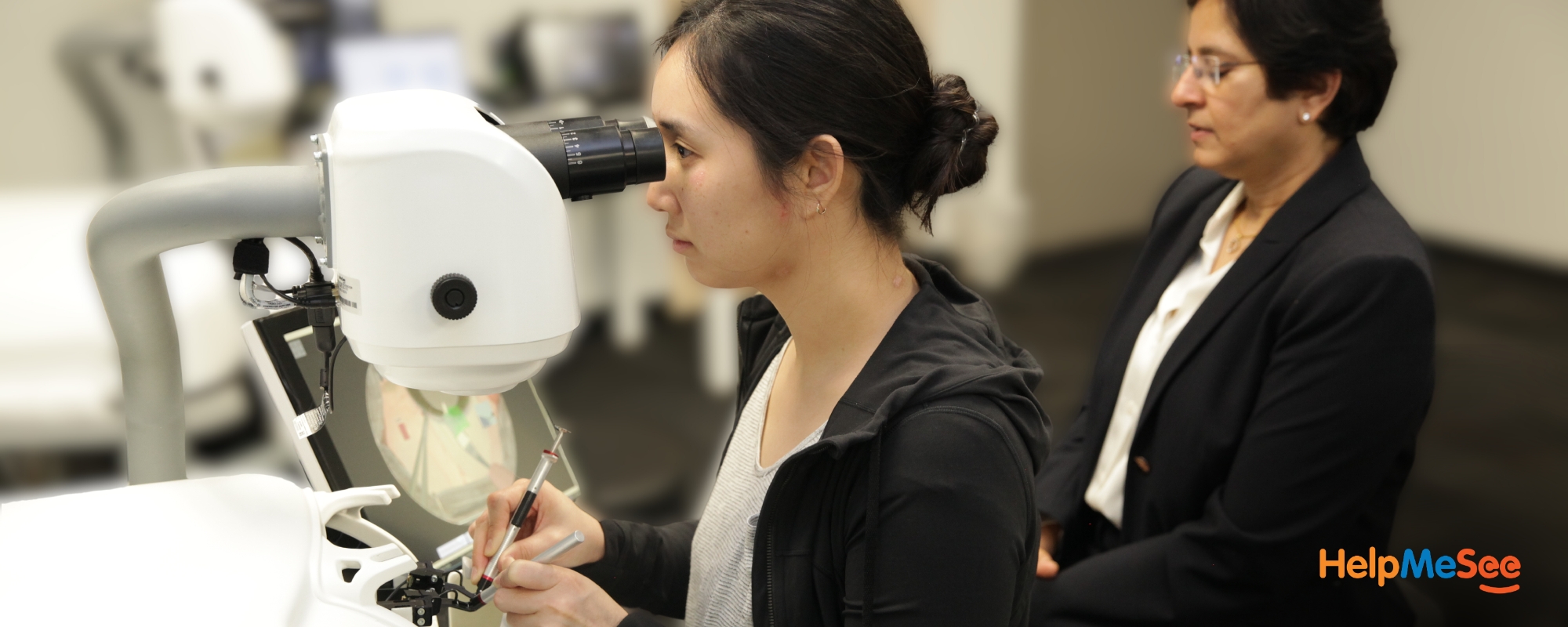
An Affordable, Scalable Model
At its core, the mission of HelpMeSee is to eliminate avoidable blindness due to cataracts through scalable surgical simulation training. Therefore, rather than selling the HelpMeSee Eye Surgery Simulator, HelpMeSee provides access to its high-fidelity training system.
The shift in service model from equipment ownership to training access helps remove the capital investment and additional cost barriers that often limit VR surgical simulation adoption. HelpMeSee offers a subscription-based, service-oriented approach that eliminates not only the hardware purchase cost but also installation fees, and maintenance contracts. It also democratizes access to advanced surgical simulation and has a lower cost per trainee, enabling greater reach across a wide range of geographies and budgets.

Addressing a Global Crisis
Both HelpMeSee and EyeSi have demonstrated the ability to improve real-world cataract surgical performance 2,5 and help address the growing global crisis associated with cataract-induced impaired vision and blindness. A randomized, controlled trial showed that trainees working on the HelpMeSee Eye Surgery Simulator made fewer errors in their first 20 independent surgeries compared to traditional training methods.7 Additionally, the instructor-led HelpMeSee learning model, which includes objective evaluations and competency assessment rubrics, helps ensure users receive external verbal feedback to promote performance improvements.8
EyeSi has shown correlations between its VR performance scores and real-life cataract surgery skills, including reduced posterior capsule rupture rates in trainees who received simulation-based training.5 Yet as the article in Clinical Ophthalmology points out, the high cost of EyeSi represents a bottleneck to widespread adoption, particularly where it is needed most.6 On the other hand, HelpMeSee has been shown to provide a scalable, efficient solution enabling more specialists to be trained faster, more effectively, and with fewer risks to patients.7
By providing access to VR surgical simulation-based training rather than selling simulators, HelpMeSee has designed a model that’s fit for purpose, ensuring that financial barriers don’t stand in the way of a life-changing surgical procedure.
- Sankarananthan R, Prasad RS, Koshy TA, et al. An objective evaluation of simulated surgical outcomes among surgical trainees using manual small-incision cataract surgery virtual reality simulator. In J Ophthalmol. 2022;70:4018-4025.
- Nair AG, Ahiwalay C, Bacchav AE, Sheth T, Lansingh VC. Assessment of a high-fidelity, virtual reality-based, manual small-incision cataract surgery simulator: a face and content validity study. In J Ophthalmol. 2022;70:4010-4015.
- Lansingh VC, Ravindran RD, Garg P, et al. Embracing technology in cataract surgical training – the way forward. In J Ophthalmol. 2022;70:4079-4081.
- Dung Le AQ, Boberg-Ans LC, Kong L, la Cour M, Bourcher T, Skou Thomsen AS. Phacoemulsification to manual small-incision cataract surgery: transfer of skills study in a simulated environment. J Cataract Refract Surg. 2024;50(12):1202-1207.
- Thomsen AS, Smith P, Subhi Y, et al. High correlation between performance on a virtual-reality simulator and real-life cataract surgery. Acta Ophthalmol. 2017;95(3):307-311.
- Ahuja AS, Paredes III AA, Eisel MLS, et al. The utility of virtual reality in ophthalmology: a review. Clin Ophthalmology. 2025;19:1683-1692.
- Nair AG, Ahiwalay C, Bacchav AE, et al. Effectiveness of simulation-based training for manual small incision cataract surgery among novice surgeons: a randomized controlled trial. Sci Rep. 2021;11:10945.
- Lansingh VC, Nair AG. More than simulation: the HelpMeSee approach to cataract surgical training. Community Eye Health Journal. 2023;36(120):4-5.


 English
  Spanish
  French