

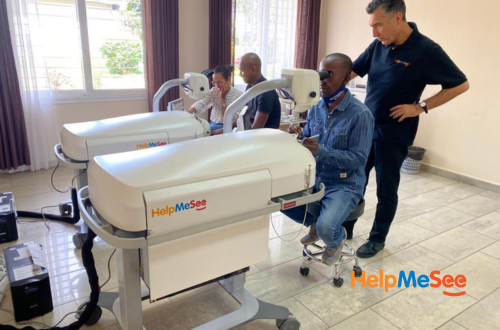
In the fight against global blindness, particularly in low- and middle-income countries (LMICs), charity-based mission trips and NGOs supporting local foundations have historically been the frontline response. While they offer immediate relief, they often fail to address the underlying issue: a lack of local, sustainable surgical capacity.
HelpMeSee is charting a different path rooted in systemic change. Through cutting-edge ophthalmic simulation-based training programs, HelpMeSee is building lasting surgical infrastructure where it’s needed most. This mission is about restoring access to cataract surgery training through simulation-based training, empowering communities, and giving donors a role in solving one of the world’s greatest unmet health needs.
The Cataract Crisis: A Global Emergency
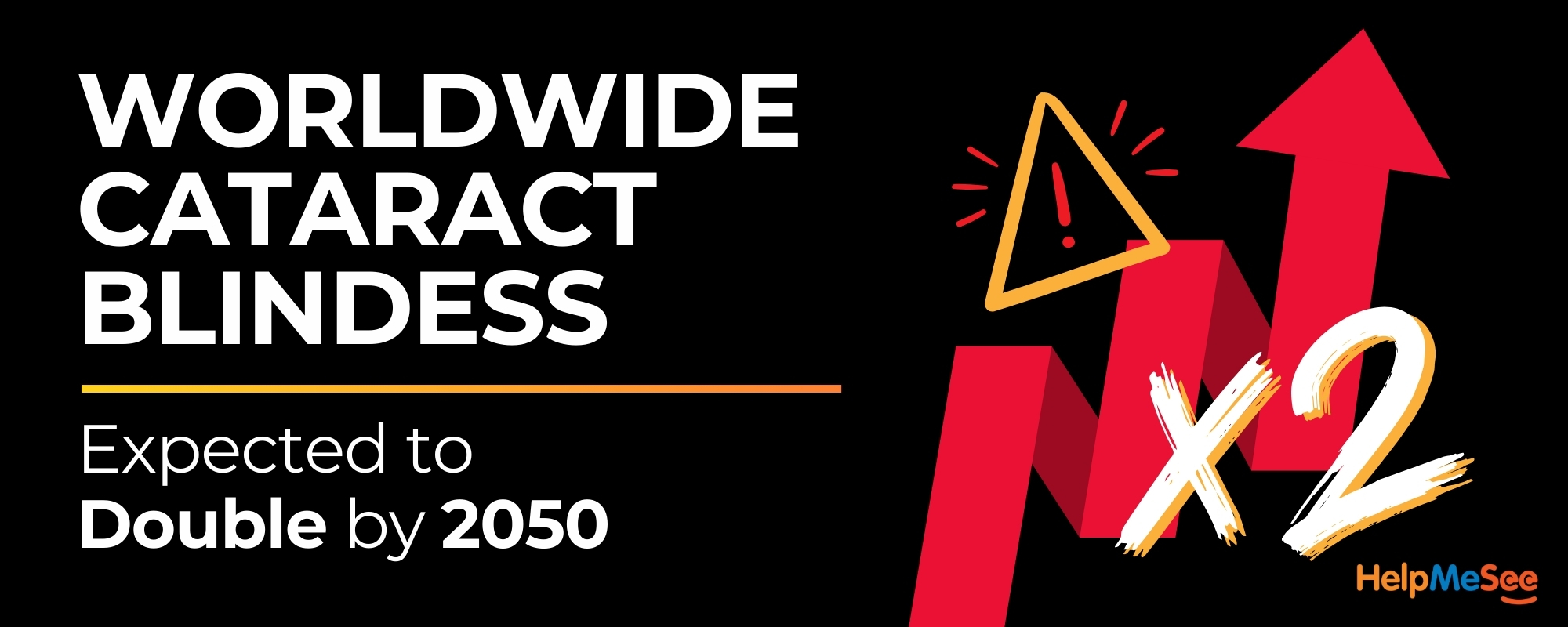
Vision loss due to cataract effects more than 100 million people worldwide and is one of the leading cause of preventable blindness. Unless the number of trained cataract surgeons increases, this burden will only grow. A recent 30-year epidemiological analysis predicts a continued rise in cataract blindness through 2050 unless long-term solutions are implemented. (1)
Scalable cataract surgery training is needed to meet this demand. The HelpMeSee Simulation-based Training Program was designed with these needs in mind, offering a comprehensive, scalable solution that supports cataract surgeons throughout their surgical journey, from foundational instrument handling to complex procedural steps.
Instead of flying in foreign teams for short-term care, HelpMeSee trains local cataract surgeons using the high-fidelity VR HelpMeSee Eye Surgery Simulator and an instructor-led curriculum. This scalable model empowers health systems and develops long-term capacity within communities. (1)
Virtual Reality (VR) simulators, especially those with haptic and tactile feedback, replicate the feel of real surgery, allowing ophthalmic professionals to develop and refine critical hand-eye coordination and fine motor control in a risk-free environment.
Three Powerful Advantages of Simulation:
- Risk-Free Repetition: Cataract surgeons practice and perform hundreds of procedures without risk to patients.
- Real-Time Feedback: Systems provide objective performance metrics, while instructors guide in real-time leading to increasing surgical skill proficiency.
- Equitable Access: HelpMeSee has high-quality training available in multiple locations worldwide, leveling the playing field for ophthalmic residents and cataract surgeons. (2)
A randomized controlled trial showed that ophthalmic trainees taught by non-ophthalmologist instructors using simulation achieved the same proficiency as those taught by expert cataract surgeons—demonstrating the power of scalable training infrastructure. (1)
Academic research continues to validate simulation-based education:
- Sensorimotor Performance: A 2025 study demonstrated that fine motor skills and sensory acuity correlate with simulator success, validating the personalized approach to surgical education. (3)
- Training Parity: Near-peer and simulation-based instruction yielded equal surgical proficiency to expert-led training in ophthalmic microsurgery, highlighting scalable educational models. (1)
- Global Trends: Over 25 training centers worldwide now require simulator certification before allowing residents to operate on patients. (4)
The Impact Grows with Your Support
When a blind person regains sight, the impact radiates: children return to school, caregivers return to work, and households regain stability. Training local cataract surgeons multiplies this impact across communities and generations.
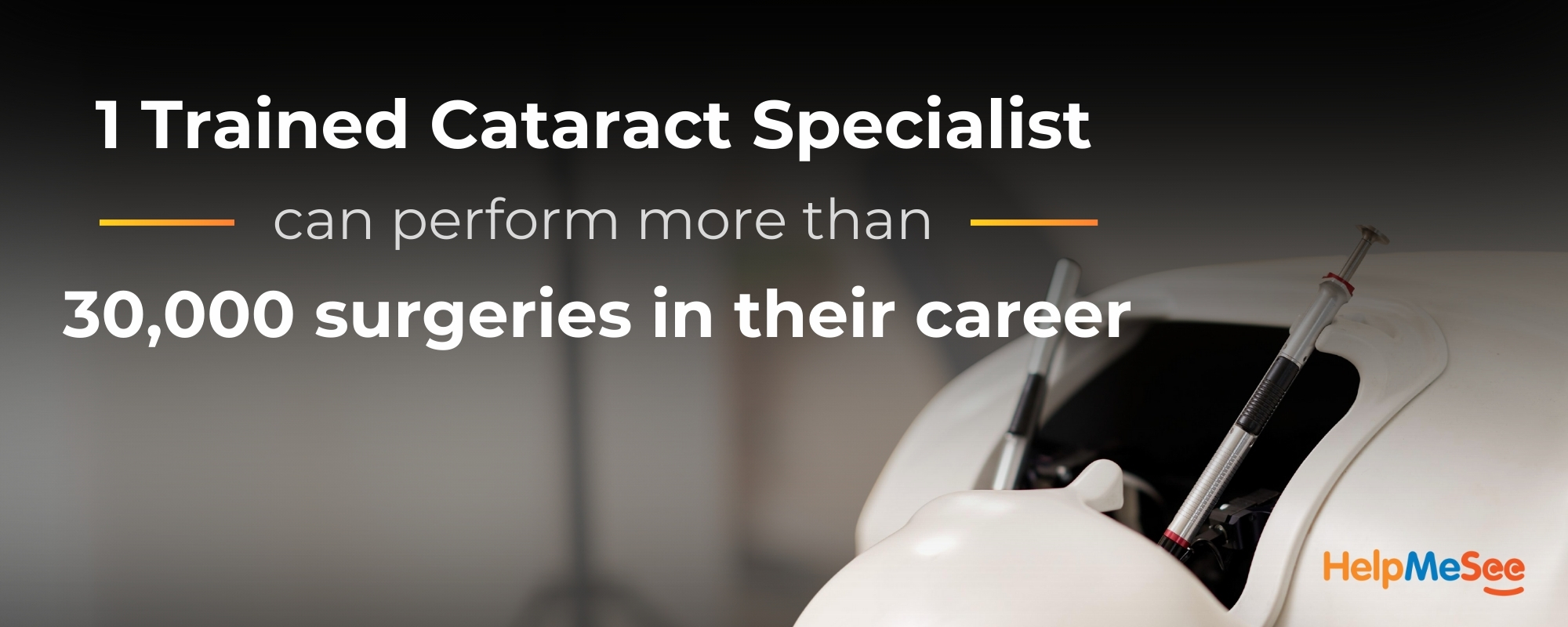
A single donation helps train a cataract surgeon who can potentially perform up to 30,000 surgeries in their career, equating to 900 million surgeries when HelpMeSee reaches their mission goal of 30,000 cataract surgeons trained by 2030.
Your donation to HelpMeSee doesn’t vanish after a mission trip ends. It invests in human infrastructure, helping build long-term solutions to global blindness.
Donate today. Build tomorrow.
- Jiang, Xiaohui, et al. “Global Trends in Cataract Burden: A 30-Year Epidemiological Analysis and Prediction of 2050 from the Global Burden of Disease 2021 Study.” British Journal of Ophthalmology, 2025. https://doi.org/10.1136/bjo-2025-327776.
- Abdulnour, Raja-Elie E., et al. “Educational Strategies for Clinical Supervision of Artificial Intelligence Use.” New England Journal of Medicine, vol. 393, no. 8, Aug. 2025, pp. 786–797.
- Bozkurt Oflaz, Ayse, et al. “Fine Motor and Sensory Proficiency: Implications for Simulator-Based Surgical Assessments.” BMC Medical Education, vol. 25, 2025, Article 1184. https://doi.org/10.1186/s12909-025-07783-7.
- Dormegny, Lea, et al. “Global Trends and Practice Patterns in Virtual Reality Simulation Training for Ophthalmic Surgery: An International Survey.” Scientific Reports, vol. 15, 2025, Article 30886. https://doi.org/10.1038/s41598-025-16227-7.


 English
  Spanish
  French