

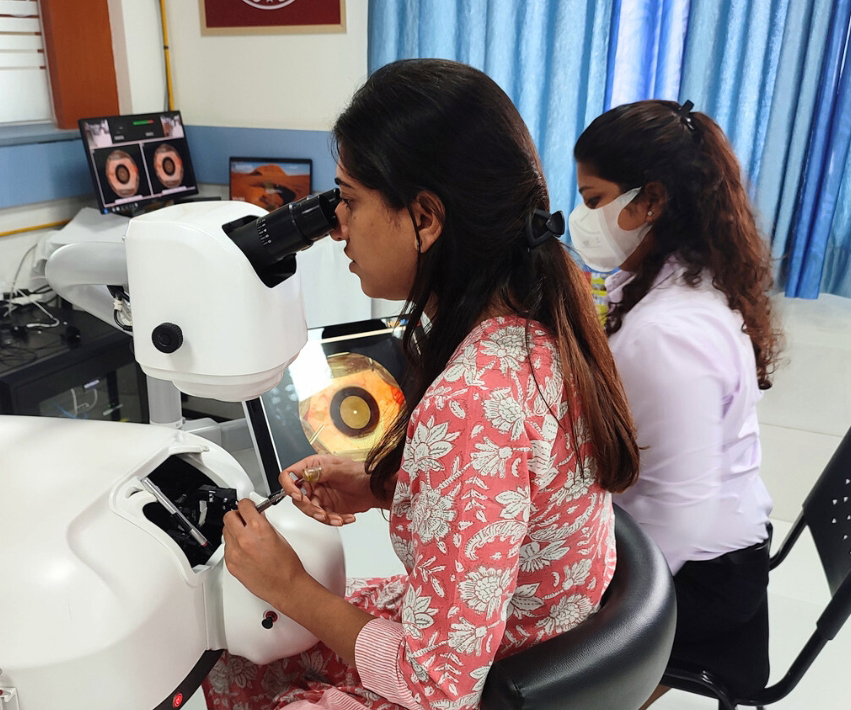
Cataract surgery is a procedure where precision matters most—and where the margin for error is razor-thin. Virtual reality (VR) simulation-based cataract surgery training is quickly redefining how cataract specialists master this delicate procedure, offering a high-fidelity, risk-free environment to develop, refine, and reinforce surgical skills.
Real-Time Feedback: The Backbone of Effective Skill Development
Immediate feedback is one of the most impactful aspects of VR simulation-based training. With platforms like the HelpMeSee Eye Surgery Simulator, cataract specialists receive real-time alerts for technical missteps—whether it’s improper instrument angling, excessive force, or inefficient movement. This on-the-spot correction not only enhances motor skills with realistic, tactile feedback but also shortens the time to competency.
A study on simulation-based education emphasizes that verbal and visual feedback from an instructor leads to lasting improvements. In instructor-led reviews, visual dashboards, and side-by-side coaching accelerate learning by combining quantitative data with experienced mentorship. This structured learning experience leads to meaningful, lasting improvements. (1,2)

Simulating the Unexpected: Training for Surgical Complications
What happens when the unexpected occurs mid-surgery? Simulation-based training prepares cataract specialists to respond with surgical confidence. Through focused repetitions, simulation-based training courses can recreate high-stakes cataract surgery complications—posterior capsule rupture, iris prolapse, nucleus drop—in a realistic setting. Through focused repetition, ophthalmic professionals build more than technical skill—they develop the critical thinking and composure required to navigate surgical emergencies. They learn not just steps of surgery, but how to respond calmly, efficiently, and correctly until managing complications becomes second nature—all without risk to patients.
Practice in simulated complication scenarios can build not only technical skill but when paired with an instructor providing feedback, it helps cataract specialists handle stressful surgeries. This ultimately can lead to faster recovery of the surgical field, and confident, decisive action during real emergencies.
Together, immediate instructor feedback, simulator alerts and repeated exposure to complications shorten the learning curve. They turn complex, rare events into familiar challenges before a cataract specialist ever sets foot in the operating room.

Global Reach, Proven Impact
Simulation-based training is being rapidly adopted around the world, driven by mounting evidence of its benefits. A 2022 narrative review highlights simulation for residents using modern tools like HelpMeSee and EyeSi simulators found the strongest evidence of improved outcomes in cataract surgery training and faster operative times. (4) This underscores global benefits—better hand–eye coordination, fewer errors, and solid evidence supporting use at scale.
International collaboration is also increasing. A thematic series by the Simulation Subcommittee of the Ophthalmology Foundation recommends building partnerships between institutions and embedding simulation into standard curricula. (3) Low- and middle-income countries are expanding access; for instance, HelpMeSee runs subsidized simulation centers in India and Madagascar. These efforts help equalize training quality and patient safety across regions.
Redefining the Future of Cataract Training
Simulation-based cataract surgery training using VR technology and tactile feedback is reshaping ophthalmic education. By combining immediate feedback, structured exposure to complications, and global implementation, its improving skill, reducing errors, and boosting confidence.
In a world facing both a growing burden of cataract blindness and a shortage of skilled cataract surgeons, simulation-based training offers a scalable, evidence-backed solution. It’s time to make simulation-based training not just an option in ophthalmic education—but the foundation.
- Bansal, S., Bhambhwani, V. Evaluation of a simulation-based ophthalmology education workshop for medical students: a pilot project. BMC Med Educ25, 153 (2025). https://doi.org/10.1186/s12909-025-06712-y
- Lansingh VC, Nair AG. More than simulation: the HelpMeSee approach to cataract surgical training. Community Eye Health. 2023;36(120):20-21. Epub 2023 Dec 1. PMID: 38178826; PMCID: PMC10762699.
- Filipe, Helena Pior, et al. “Good Practices in Simulation-Based Education in Ophthalmology: A Thematic Series.” Pan American Journal of Ophthalmology, 2023, https://www.researchgate.net/publication/376882069.
- Lowater, Simon J., et al. “Modern Educational Simulation‑Based Tools Among Residents of Ophthalmology: A Narrative Review.” Ophthalmology and Therapy, vol. 11, 2022, pp. 1961–1974, https://link.springer.com/article/10.1007/s40123-022-00559-y.


 English
  Spanish
  French