

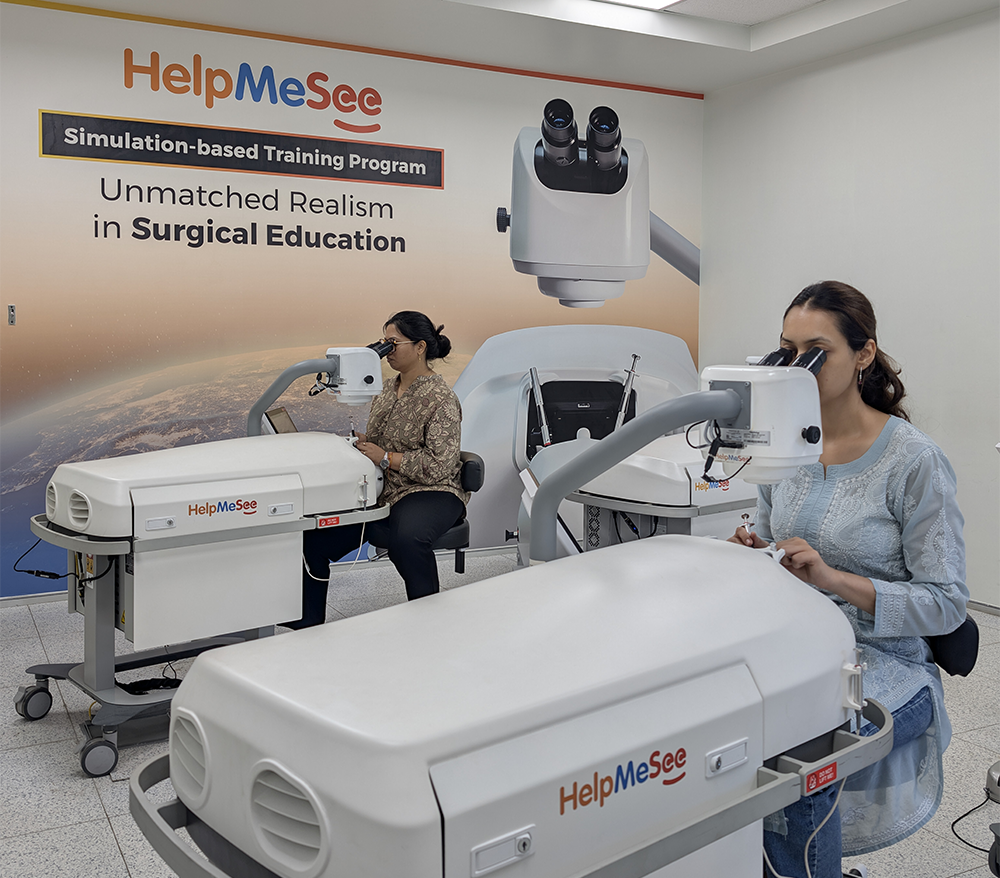
As populations continue to age and demand for cataract surgery grows, healthcare systems around the world face a common challenge: building enough surgical capacity to meet the demand. While expanding access to operating rooms and equipment is important, the greatest opportunity lies in developing the workforce itself.
Ending cataract blindness begins by training more surgeons and increasingly, simulation-based education is proving to be one of the most effective ways to prepare them for practice.
The Real Barrier to Restoring Sight
Every cataract surgery restores sight to one patient.
Every cataract surgeon trained has the potential to restore sight to thousands over the course of a career.
The World Health Organization’s Effective Cataract Surgical Coverage (eCSC) indicator emphasizes that improving access to quality cataract surgery depends not only on increasing surgical volume to people in need, but also on expanding the number of proficient surgeons capable of delivering safe, high-quality care.¹
Across many low- and middle-income countries, surgical demand continues to grow faster than the ophthalmology workforce. As a result, millions of people remain blind from a condition that is entirely treatable.
Rather than asking how to perform more surgeries today, healthcare leaders are increasingly asking a different question: How do we train enough surgeons to meet tomorrow’s demand?
Sub-Saharan Africa Highlights the Workforce Challenge
Nowhere is this challenge more visible than in Sub-Saharan Africa.
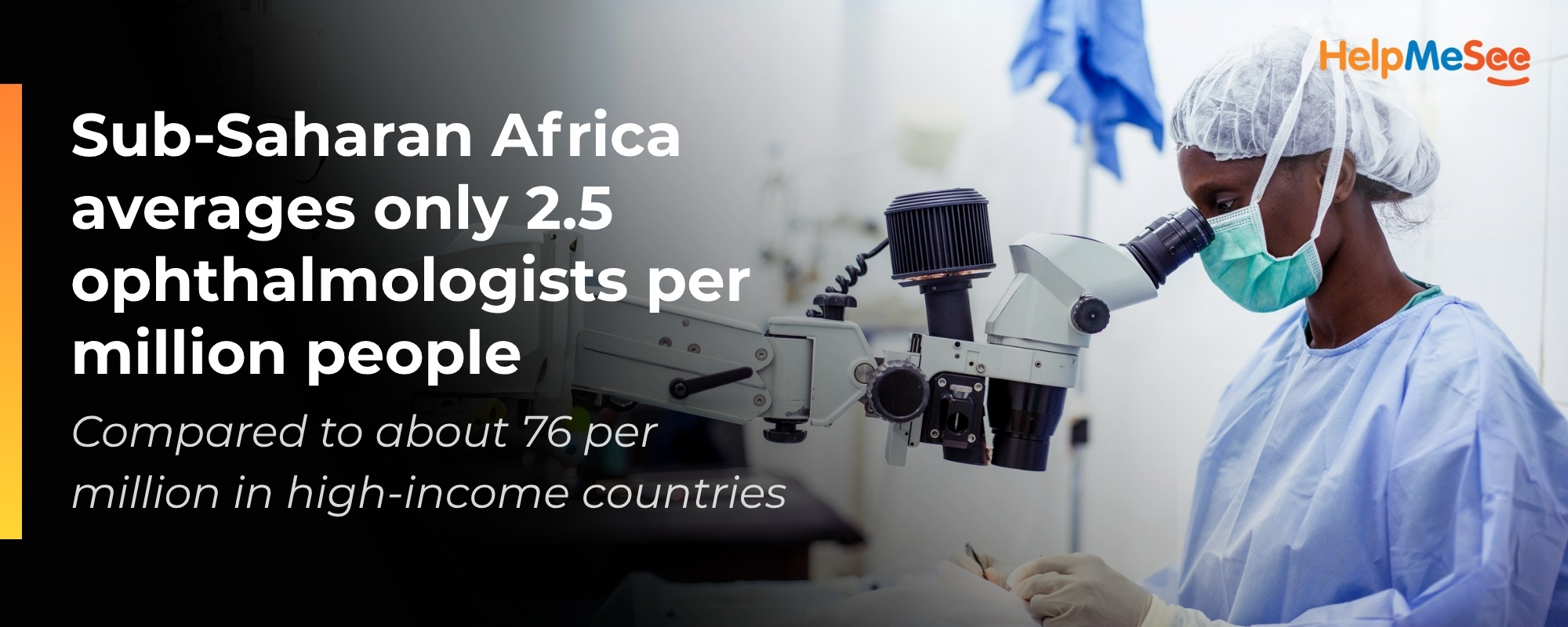
Although the region represents approximately 17% of the world’s population, it carries one of the greatest burdens of avoidable blindness. Cataract remains the leading cause of blindness, yet many patients are unable to access surgery because there are simply too few trained eye surgeons available.
The International Agency for the Prevention of Blindness reports that high-income countries average approximately 76 ophthalmologists per million people, while low-income countries average only about four. In several countries across Sub-Saharan Africa, there are fewer than one ophthalmologist per million people.²
For many patients, the nearest cataract surgeon may be hours away or unavailable altogether.
This shortage affects far more than individual patients. Delayed cataract surgery impacts families, limits workforce participation, reduces educational opportunities, and places additional strain on healthcare systems.
Addressing these challenges requires more than increasing surgical services. It requires increasing the number of surgeons who can provide those services within their own communities.
Why Traditional Surgical Training Cannot Keep Pace
For generations, cataract surgeons have learned through apprenticeship in the operating room. This model remains essential, but it also presents significant limitations. Operating room time is limited. Faculty supervision is resource-intensive. Most importantly, patient safety appropriately limits how much novice surgeons can learn through repeated trial and error during live surgery.
As healthcare systems work to expand cataract surgical capacity, educators are seeking methods that allow trainees to develop additional ways to expand technical proficiency before operating on patients.
Simulation-based education has emerged as one of the most important advances in ophthalmic surgical training, because it allows surgeons to practice repeatedly without placing patients at risk. Simulation-based learning gives cataract surgeons something traditional training cannot always provide: unlimited opportunities for deliberate practice.
Using high-fidelity virtual reality simulators with haptic feedback, lead by an experienced intructor, cataract surgery trainees can repeatedly perform complex surgical steps, receive immediate objective feedback, identify technical errors, and improve performance before entering the operating room. This approach allows mistakes to become learning opportunities rather than patient complications.
Research continues to demonstrate the value of this educational model.
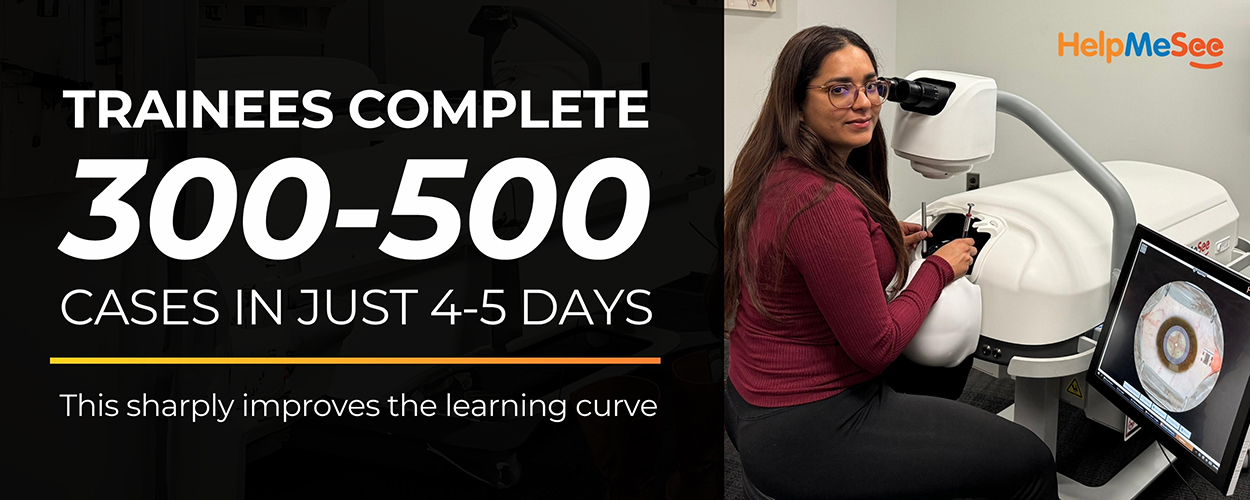
A national survey of U.S. ophthalmology residency programs found that most faculty using virtual reality simulation believed residents became more confident during live surgery, experienced fewer surgical complications, and completed cataract procedures more efficiently after simulation was integrated into training.³
Simulation is also helping surgeons develop critical non-technical skills.
A recent study demonstrated that structured simulation with guided debriefing significantly improved communication, situational awareness, decision-making, leadership, and other non-technical skills that contribute to safe surgical performance. ⁴
Researchers have also shown that recreating a realistic operating room environment including interactions with surgical staff, patient communication, and common operating room scenarioshelps prepare cataract surgeons for the realities of live surgery while maintaining technical performance.⁵
Together, these studies reinforce an important shift in surgical education: simulation is no longer viewed simply as a supplement to training. It is becoming a foundational component of preparing surgeons for clinical practice.
Building Local Cataract Surgical Capacity
The benefits of simulation-based education become even more meaningful when integrated into local healthcare systems.
Across Sub-Saharan Africa, governments, universities, teaching hospitals, and nonprofit organizations are increasingly investing in simulation-based education to strengthen local cataract surgery training programs. Rather than relying solely on overseas fellowships or visiting surgical missions, institutions are building sustainable educational infrastructure that prepares surgeons within their own countries.
Nigeria provides a powerful example of this approach.
The establishment of the HelpMeSee Simulation-based Cataract Surgery Training Centre at the Eleta Eye Institute in Ibadan marked an important milestone in expanding local surgical education.
Among its first trainees was Dr. Ubong Idant Fingesi, Nigeria’s first in-country HelpMeSee-trained resident ophthalmologist. He is a second-year resident at Babcock University Teaching Hospital in Ilishan, that transition once felt uncertain until he experienced simulation-based training with HelpMeSee at the Simulation Training Centre in Eleta Eye Institute Ibadan, Nigeria, which was established in collaboration with Christian Blind Mission. Before simulation-based training, he described the transition from practicing on goat eyes to operating on patients as intimidating. Following intensive simulation training, he reported that his confidence nearly doubled as he prepared for live surgery.
His experience illustrates what simulation-based education can achieve.
Training one surgeon does more than improve one career -it expands long-term surgical capacity for an entire healthcare system. Every locally trained cataract surgeon represents thousands of future patients who may regain their sight without leaving their own communities.
The Future of Cataract Blindness Depends on Simulation-based Training
The world’s cataract backlog will not be solved one surgery at a time, although it starts there, but it will be solved by preparing thousands more skilled cataract surgeons who can safely restore sight throughout their careers.
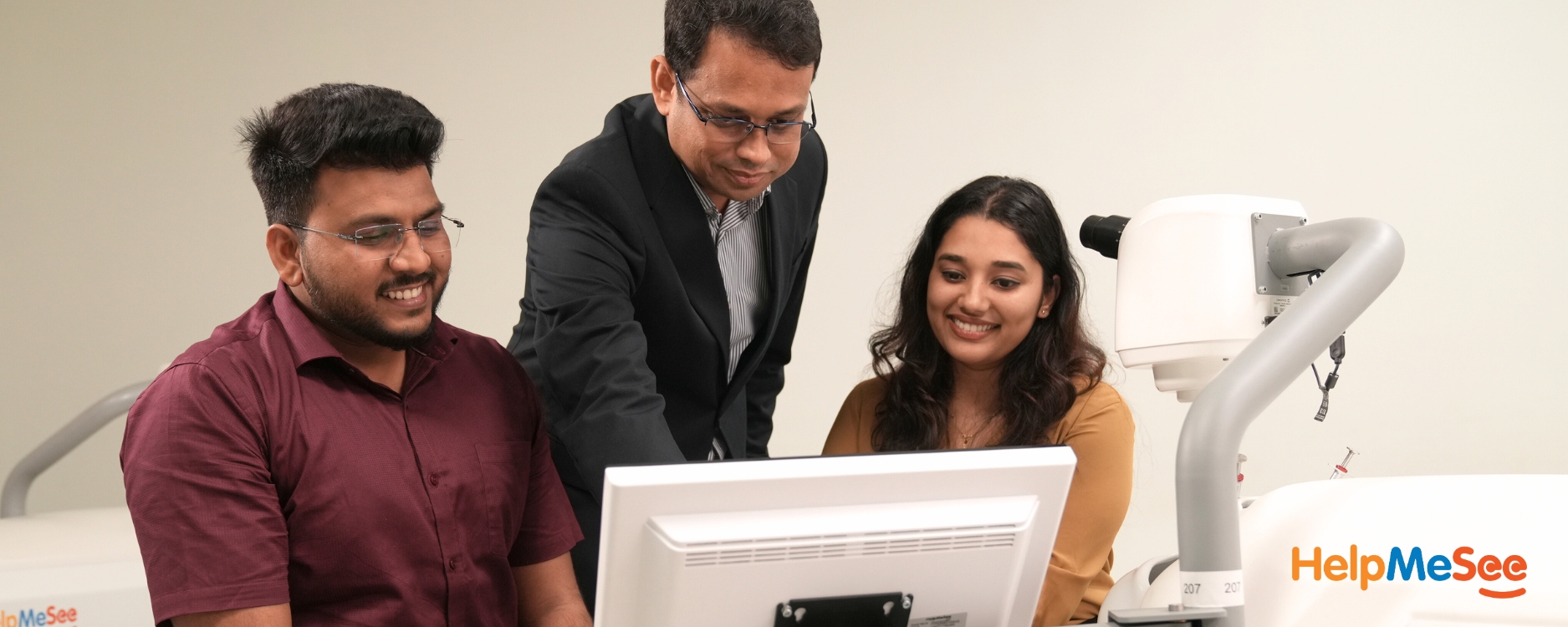
Simulation-based education enables institutions to standardize training, objectively measure competency, accelerate surgical readiness, and strengthen the transition from simulation to supervised live surgery. By investing in qualityrather than simply increasing surgical volume, healthcare systems create lasting capacity that continues serving patients for decades.
That is why simulation-based education has become one of the highest-impact investments in global eye health.
Through simulation-based training, competency-based curricula, instructor-guided education, and partnerships with universities, teaching hospitals, ministries of health, and nonprofit organizations, HelpMeSee is helping institutions strengthen their cataract surgery workforce and expand access to quality eye care.
Every surgeon trained strengthens a healthcare system.
Every new training partnership builds local capacity.
Every new cataract surgeon creates the opportunity for thousands more people to regain their sight.
If your institution is interested in expanding cataract surgery training or integrating simulation-based education into your curriculum, learn how HelpMeSee can help build the next generation of cataract surgeons.
REFERENCES
- McCormick, Ian, Yamna Ouchtar, David Macleod, Anna Harte, Maria Vittoria Cicinelli, Tabassom Sedighi, Emma Jolley, Thulasiraj D. Ravilla, Michael Gichangi, Yiwen Huang, Ningli Wang, Mohamad Aziz Salowi, Sailesh Kumar Mishra, Rupert R. A. Bourne, Serge Resnikoff, Stuart Keel, Matthew J. Burton, Jacqueline Ramke, and the eCSC Study Group. “Effective Cataract Surgical Coverage in Adults Aged 50 Years and Older: Empirical Estimates from Population-Based Surveys in 68 Countries and Modelled Estimates for 2000–30.” The Lancet Global Health, vol. 14, no. 3, 2026, pp. e367–e377. https://doi.org/10.1016/S2214-109X(25)00435-8
- Bourne, Rupert R. A., et al. “Trends in Prevalence of Blindness and Distance and Near Vision Impairment Over 30 Years.” The Lancet Global Health, 2021.
- Nguyen, Geoffrey, Mackenzie T. Pham, and Paul C. Kang. “The Use and Perceptions of Virtual Reality Simulator Training for Ophthalmological Surgical Education.” Journal of Academic Ophthalmology, vol. 18, no. 1, 2026, article 12. Association of University Professors of Ophthalmology, https://doi.org/10.62199/2475-4757.1340
- Solecki, Lauriana, Rémi Yaïci, Léonard Sidhoum, Nabil Chakfé, Anne Lejay, Nicole Neumann, Emilia Koestel, Salome Kuntz, David Gaucher, Arnaud Sauer, Léa Dormegny, and Tristan Bourcier. “Virtual Reality Simulator-Based Assessment of Non-Technical Skills in Eye Surgery: Managing Complex Cataract Surgery.” BMC Medical Education, vol. 26, 2026, article 828. Springer Nature, 10 Apr. 2026, https://doi.org/10.1186/s12909-026-09029-6
- Martin, Gilles C., Arnaud Huaulmé, Mathieu Cavaillé, Ilian Cruz-Panesso, Joëlle Lacoste de Lamirande, Simon Trottier, Ralph Kyrillos, Isabelle Hardy, Pierre Jannin, Issam Tanoubi, and Frédéric Mouriaux. “Cataract Surgery in a Simulated Operating Room Environment: A Pilot Study.” Canadian Journal of Ophthalmology, 2026, doi:10.1016/j.jcjo.2026.03.002.


 English
  Spanish
  French